素 (sù) means "plain; white; vegetarian" in Chinese. It has 10 strokes with the radical 糸, and is HSK Level 6.
Rated 4.2/5 in difficulty (advanced).
Harder than 84% of HSK Level 6 characters.
Appears in 3+ common words including 素食 (sù shí), 素菜 (sù cài), 因素 (yīn sù).
Due to its 10 strokes, Hanzi Writer's error detection shows 素 requires focused practice — most learners need 10+ attempts for consistent accuracy.
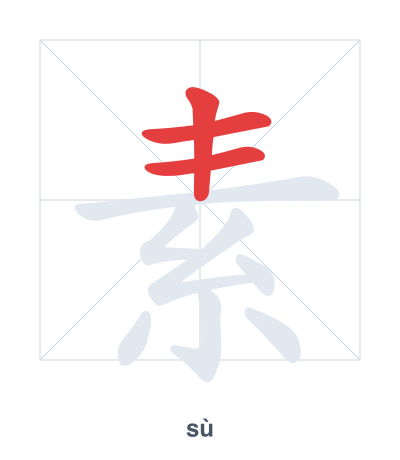
Open Hanzi Writer to see the animated stroke order and practice writing 素 with real-time feedback.
The character 素 (sù) is written with 10 strokes. Follow the standard Chinese stroke order: top to bottom, left to right, outside before inside. The radical 糸 is one of its key components.
Practice the correct stroke order with the Hanzi Writer app to see animated stroke-by-stroke guidance with real-time feedback.
素 means plain; white; vegetarian.
As an HSK Level 6 character, 素 is an intermediate-level character.
The character 素 originally depicted a bundle of silk threads (糸) hanging down (垂), representing undyed, plain silk. Over time, it came to mean 'plain, white, unadorned' and later 'vegetarian' as simple food.
💡 Memory Tip: Picture a plain white T-shirt: the top part (龹) is the collar, and the bottom (糸) is the thread — simple and unadorned.
我吃素食。
wǒ chī sù shí
I am a vegetarian.
我喜欢吃素菜。
wǒ xǐ huān chī sù cài
I like eating vegetarian dishes.
这是重要的因素。
zhè shì zhòng yào de yīn sù
This is an important factor.
Open Hanzi Writer to see the animated stroke order and practice writing 素 with real-time feedback.
✨ Animated stroke order · Handwriting recognition · HSK-graded practice · Free to use
The character 素 consists of the radical 糸 (silk) on the bottom and a top component derived from the character for "white" or "uncolored." The silk radical hints that its original meaning was "undyed silk," which evolved into the meanings of "plain" and "white." This connection helps explain why 素 is also used for "vegetarian" – food that is plain and without meat.