紥 (zā) means "Tie" in Chinese. It has 10 strokes with the radical 糸.
Rated 4.2/5 in difficulty (advanced).
Appears in 3+ common words including 紥实 (zā shí), 紥头发 (zā tóu fà), 捆紥 (kǔn zā).
Due to its 10 strokes, Hanzi Writer's error detection shows 紥 requires focused practice — most learners need 10+ attempts for consistent accuracy.
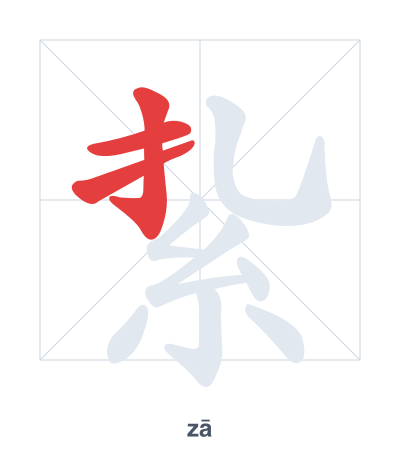
Open Hanzi Writer to see the animated stroke order and practice writing 紥 with real-time feedback.
The character 紥 (zā) is written with 10 strokes. Follow the standard Chinese stroke order: top to bottom, left to right, outside before inside. The radical 糸 is one of its key components.
Practice the correct stroke order with the Hanzi Writer app to see animated stroke-by-stroke guidance with real-time feedback.
紥 means Tie.
| Character | 紥 |
| Pinyin | zā (za) |
| Meaning | Tie |
| Strokes | 10 |
| Radical | 糸 |
| Difficulty | 4.2/5 |
紥 is a phono-semantic compound: the radical 糸 (silk thread) indicates the material used for tying, while 扎 (zā) provides the pronunciation and adds the sense of binding or tightening. Together, they depict tying something securely with a thread or cord.
💡 Memory Tip: Imagine a silk thread (糸) wrapping around a bundle and then being pulled tight with a sharp 'zap' (扎) to make a secure tie.
他的基础很紥实。
tā de jī chǔ hěn zā shí
His foundation is very solid.
她在紥头发。
tā zài zā tóu fà
She is tying her hair.
把东西捆紥好。
bǎ dōng xī kǔn zā hǎo
Tie the things up securely.
Open Hanzi Writer to see the animated stroke order and practice writing 紥 with real-time feedback.
✨ Animated stroke order · Handwriting recognition · HSK-graded practice · Free to use
紥 is composed of 糸 (silk thread) on the left and 扎 (to tie or pierce) on the right. The silk radical hints at binding with thread, while 扎 adds the action of fastening. Together they reinforce the meaning of tying or binding something securely.