絜 (jié) means "clean; pure" in Chinese. It has 12 strokes with the radical 糸.
Rated 4.2/5 in difficulty (advanced).
Appears in 3+ common words including 絜静 (jié jìng), 絜矩 (jié jǔ), 廉絜 (lián jié).
Due to its 12 strokes, Hanzi Writer's error detection shows 絜 requires focused practice — most learners need 10+ attempts for consistent accuracy.
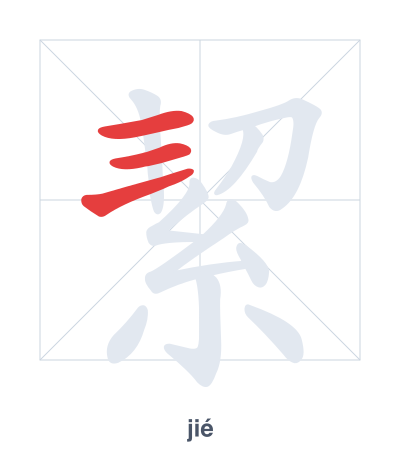
Open Hanzi Writer to see the animated stroke order and practice writing 絜 with real-time feedback.
The character 絜 (jié) is written with 12 strokes. Follow the standard Chinese stroke order: top to bottom, left to right, outside before inside. The radical 糸 is one of its key components.
Practice the correct stroke order with the Hanzi Writer app to see animated stroke-by-stroke guidance with real-time feedback.
絜 means clean; pure.
| Character | 絜 |
| Pinyin | jié (jie) |
| Meaning | clean; pure |
| Strokes | 12 |
| Radical | 糸 |
| Difficulty | 4.2/5 |
絜 combines the radical 糸 (silk) with 㓞 (a hand holding a knife), evoking the act of cutting silk to produce a clean, even edge—thus symbolizing purity and cleanliness.
💡 Memory Tip: Imagine a pure silk thread (糸) being sliced perfectly clean by a knife (㓞), leaving no frayed edges.
房间很絜静。
fáng jiān hěn jié jìng
The room is clean and quiet.
做人要守絜矩。
zuò rén yào shǒu jié jǔ
One should follow the principle of fairness and reciprocity.
他为人很廉絜。
tā wéi rén hěn lián jié
He is very honest and incorruptible.
Open Hanzi Writer to see the animated stroke order and practice writing 絜 with real-time feedback.
✨ Animated stroke order · Handwriting recognition · HSK-graded practice · Free to use
絜 is made of two parts: the top is 㓞 (qià, meaning to cut or engrave) and the bottom is 糸 (silk thread). Together, the idea of cutting silk to make it neat and clean gives the character its meaning of "clean" or "pure."