紧 (jǐn) means "tight, urgent" in Chinese. It has 10 strokes with the radical 糸, and is HSK Level 3.
Rated 4.2/5 in difficulty (advanced).
Harder than 89% of HSK Level 3 characters.
Appears in 3+ common words including 紧张 (jǐn zhāng), 赶紧 (gǎn jǐn), 抓紧 (zhuā jǐn).
Due to its 10 strokes, Hanzi Writer's error detection shows 紧 requires focused practice — most learners need 10+ attempts for consistent accuracy.
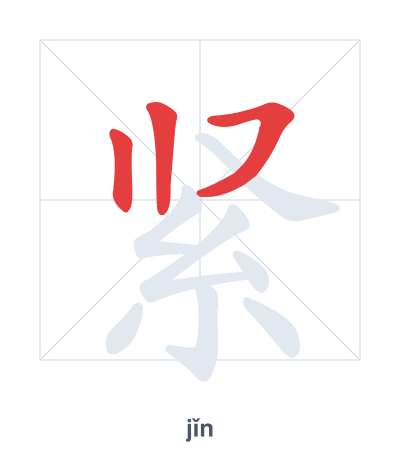
Open Hanzi Writer to see the animated stroke order and practice writing 紧 with real-time feedback.
The character 紧 (jǐn) is written with 10 strokes. Follow the standard Chinese stroke order: top to bottom, left to right, outside before inside. The radical 糸 is one of its key components.
Practice the correct stroke order with the Hanzi Writer app to see animated stroke-by-stroke guidance with real-time feedback.
紧 means tight, urgent.
As an HSK Level 3 character, 紧 is an intermediate-level character.
The character 紧 (simplified from 緊) combines 糸 (silk thread) on the bottom with a top part derived from 堅 (firm/strong). Originally, it depicted silk strands pulled tense, conveying the meanings 'tight' and 'urgent.'
💡 Memory Tip: Picture a person (the top part resembling a kneeling figure) desperately pulling a silk thread (糸) so tight it's about to snap—urgent!
他考试很紧张。
tā kǎo shì hěn jǐn zhāng
He is very nervous about the exam.
我们赶紧走吧。
wǒ men gǎn jǐn zǒu ba
Let's hurry and leave.
请抓紧时间。
qǐng zhuā jǐn shí jiān
Please hurry up.
Open Hanzi Writer to see the animated stroke order and practice writing 紧 with real-time feedback.
✨ Animated stroke order · Handwriting recognition · HSK-graded practice · Free to use
紧 is composed of 糸 (silk thread) on top and 小 (small) modified with extra strokes below, though the bottom part originally relates to "hand" or "action." The silk thread suggests tying or binding, which connects to the meanings of "tight" and "urgent" because something tied tightly feels tense or requires immediate attention.