亡 (wáng) means "to die; to lose; to perish" in Chinese. It has 3 strokes with the radical 亠, and is HSK Level 6.
Rated 2.2/5 in difficulty (moderate).
Harder than 0% of HSK Level 6 characters.
Appears in 3+ common words including 死亡 (sǐ wáng), 逃亡 (táo wáng), 亡羊补牢 (wáng yáng bǔ láo).
Hanzi Writer's stroke validation shows learners typically need 5-8 attempts to write 亡 with correct proportion and order.
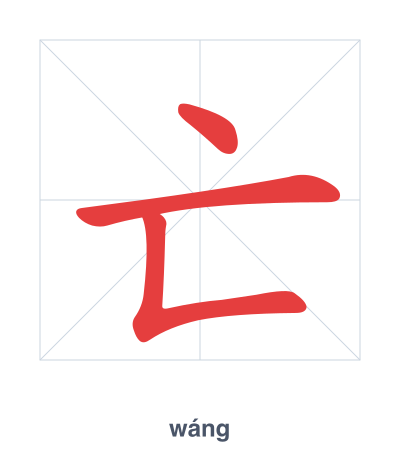
Open Hanzi Writer to see the animated stroke order and practice writing 亡 with real-time feedback.
The character 亡 (wáng) is written with 3 strokes. Follow the standard Chinese stroke order: top to bottom, left to right, outside before inside. The radical 亠 is one of its key components.
Practice the correct stroke order with the Hanzi Writer app to see animated stroke-by-stroke guidance with real-time feedback.
亡 means to die; to lose; to perish.
As an HSK Level 6 character, 亡 is an intermediate-level character.
In ancient oracle bone script, 亡 was a pictograph of a person hiding in a corner or cave, originally meaning 'to flee' or 'to disappear.' Over time, the meaning extended to 'to die' or 'to perish,' as someone who vanishes from life.
💡 Memory Tip: Imagine a person with a hat (亠) slipping and falling into a bottomless pit, never to be seen again — that's 亡 (death).
这种植物已经死亡。
zhè zhòng zhí wù yǐ jīng sǐ wáng
This plant is already dead.
他开始了逃亡生活。
tā kāi shǐ le táo wáng shēng huó
He began a life on the run.
亡羊补牢还不晚。
wáng yáng bǔ láo hái bù wǎn
It is not too late to mend the fold after the sheep are lost.
Open Hanzi Writer to see the animated stroke order and practice writing 亡 with real-time feedback.
✨ Animated stroke order · Handwriting recognition · HSK-graded practice · Free to use
亡 has two parts: the top radical 亠 (a dot and a horizontal line) and a curved stroke 乚 below. The shape can be seen as a person bending down or hiding, which connects to ideas of loss or disappearance. This simple structure visually suggests something being covered or sinking away, matching meanings like to die or to perish.