墅 (shù) means "villa" in Chinese. It has 14 strokes with the radical 土, and is HSK Level 7.
Rated 4.2/5 in difficulty (advanced).
Harder than 50% of HSK Level 7 characters.
Appears in 3+ common words including 别墅 (bié shù), 郊墅 (jiāo shù), 墅区 (shù qū).
Due to its 14 strokes, Hanzi Writer's error detection shows 墅 requires focused practice — most learners need 10+ attempts for consistent accuracy.
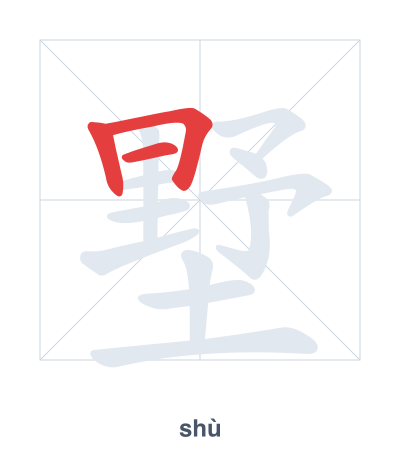
Open Hanzi Writer to see the animated stroke order and practice writing 墅 with real-time feedback.
The character 墅 (shù) is written with 14 strokes. Follow the standard Chinese stroke order: top to bottom, left to right, outside before inside. The radical 土 is one of its key components.
Practice the correct stroke order with the Hanzi Writer app to see animated stroke-by-stroke guidance with real-time feedback.
墅 means villa.
As an HSK Level 7 character, 墅 is an intermediate-level character.
墅 is a compound character: the bottom is 土 (earth, land) and the top is 予 (yǔ, 'to give' or 'to extend'). Together, they suggest a piece of land given or set aside for building a country house or villa, reflecting the idea of a private rural estate.
💡 Memory Tip: Imagine receiving a gift (予) of a luxurious villa built on prime land (土).
他买了一套别墅。
tā mǎi le yī tào bié shù
He bought a villa.
郊墅空气清新。
jiāo shù kōng qì qīng xīn
The air at the suburban villa is fresh.
这个墅区很安静。
zhè ge shù qū hěn ān jìng
This villa area is very quiet.
Open Hanzi Writer to see the animated stroke order and practice writing 墅 with real-time feedback.
✨ Animated stroke order · Handwriting recognition · HSK-graded practice · Free to use
墅 is composed of 予 (yǔ, meaning 'to give') on top and 土 (tǔ, meaning 'earth' or 'ground') below. The top part suggests a structure or building given to the land, while the bottom 土 indicates the ground on which a villa is built. Together they represent a house situated on land, matching the meaning 'villa'.