逝 (shì) means "To pass away or elapse." in Chinese. It has 10 strokes with the radical 辶, and is HSK Level 7.
Rated 4.2/5 in difficulty (advanced).
Harder than 93% of HSK Level 7 characters.
Appears in 3+ common words including 逝世 (shì shì), 流逝 (liú shì), 消逝 (xiāo shì).
Due to its 10 strokes, Hanzi Writer's error detection shows 逝 requires focused practice — most learners need 10+ attempts for consistent accuracy.
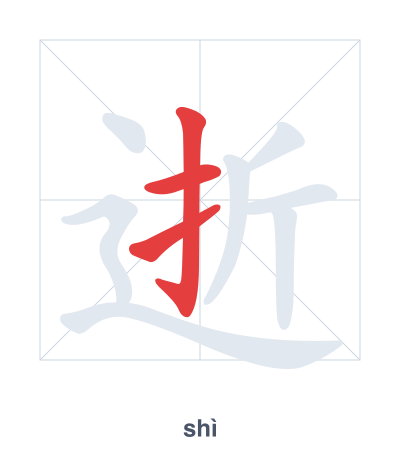
Open Hanzi Writer to see the animated stroke order and practice writing 逝 with real-time feedback.
The character 逝 (shì) is written with 10 strokes. Follow the standard Chinese stroke order: top to bottom, left to right, outside before inside. The radical 辶 is one of its key components.
Practice the correct stroke order with the Hanzi Writer app to see animated stroke-by-stroke guidance with real-time feedback.
逝 means To pass away or elapse..
As an HSK Level 7 character, 逝 is an intermediate-level character.
逝 combines the radical 辶 (walk/movement) with 折 (to break or bend). The ancient meaning suggests a broken journey or departure, which evolved to signify time or life passing away like a fractured path moving onward.
💡 Memory Tip: Imagine a broken arrow (折) slowly walking away (辶) as time slips from your grasp.
那位老人去年逝世了。
nà wèi lǎo rén qù nián shì shì le
That old man passed away last year.
时间流逝得很快。
shí jiān liú shì dé hěn kuài
Time passes very quickly.
烟雾很快就消逝了。
yān wù hěn kuài jiù xiāo shì le
The smoke soon vanished.
Open Hanzi Writer to see the animated stroke order and practice writing 逝 with real-time feedback.
✨ Animated stroke order · Handwriting recognition · HSK-graded practice · Free to use
逝 is formed by the left component 折 (meaning to break or twist) and the radical 辶 (meaning walk or movement). Together, they suggest the idea of something 'breaking away' as it moves, which connects to the meanings of passing away or time elapsing.