湿 (shī) means "Wet; damp; humid." in Chinese. It has 12 strokes with the radical 氵, and is HSK Level 4.
Rated 4.2/5 in difficulty (advanced).
Harder than 78% of HSK Level 4 characters.
Appears in 3+ common words including 湿润 (shī rùn), 潮湿 (cháo shī), 弄湿 (nòng shī).
Due to its 12 strokes, Hanzi Writer's error detection shows 湿 requires focused practice — most learners need 10+ attempts for consistent accuracy.
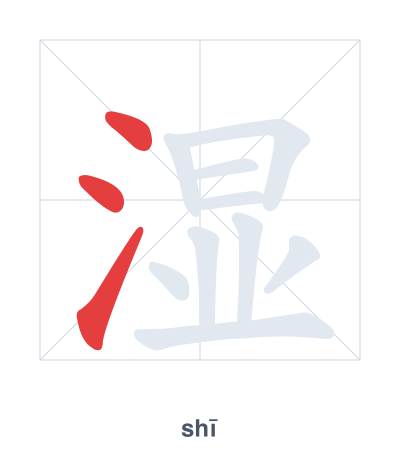
Open Hanzi Writer to see the animated stroke order and practice writing 湿 with real-time feedback.
The character 湿 (shī) is written with 12 strokes. Follow the standard Chinese stroke order: top to bottom, left to right, outside before inside. The radical 氵 is one of its key components.
Practice the correct stroke order with the Hanzi Writer app to see animated stroke-by-stroke guidance with real-time feedback.
湿 means Wet; damp; humid..
As an HSK Level 4 character, 湿 is an intermediate-level character.
湿 is a compound character: the radical 氵 (water) indicates moisture, and the right side 显 (xiǎn, 'to manifest') suggests that wetness makes things visible or apparent. In the traditional form 濕, the right component 㬎 depicted wet silk, reinforcing the idea of dampness.
💡 Memory Tip: Imagine a water drop (氵) on a sunny day (日) making the ground so damp that the sun itself looks blurry—water manifesting as wetness.
这里的空气很湿润。
zhè lǐ de kōng qì hěn shī rùn
The air here is very humid.
地下室非常潮湿。
dì xià shì fēi cháng cháo shī
The basement is very damp.
别把衣服弄湿了。
bié bǎ yī fú nòng shī le
Don't get your clothes wet.
Open Hanzi Writer to see the animated stroke order and practice writing 湿 with real-time feedback.
✨ Animated stroke order · Handwriting recognition · HSK-graded practice · Free to use
The left side is the water radical 氵, which directly connects the character to water and moisture. The right side is 显 (xiǎn), meaning "to manifest" or "appear," so together they suggest water becoming visible, like a wet spot.