牲 (shēng) means "Livestock / Sacrificial animal" in Chinese. It has 9 strokes with the radical 牛, and is HSK Level 6.
Rated 4/5 in difficulty (challenging).
Harder than 51% of HSK Level 6 characters.
Appears in 3+ common words including 牺牲 (xī shēng), 牲口 (shēng kǒu), 畜牲 (chù shēng).
Due to its 9 strokes, Hanzi Writer's error detection shows 牲 requires focused practice — most learners need 10+ attempts for consistent accuracy.
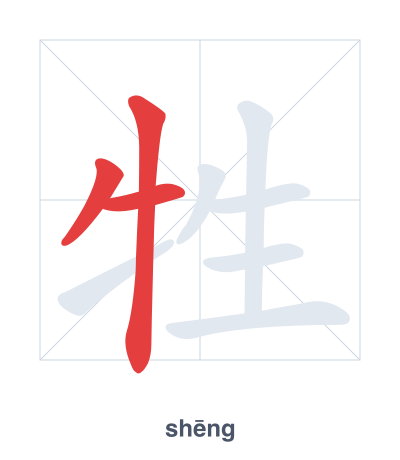
Open Hanzi Writer to see the animated stroke order and practice writing 牲 with real-time feedback.
The character 牲 (shēng) is written with 9 strokes. Follow the standard Chinese stroke order: top to bottom, left to right, outside before inside. The radical 牛 is one of its key components.
Practice the correct stroke order with the Hanzi Writer app to see animated stroke-by-stroke guidance with real-time feedback.
牲 means Livestock / Sacrificial animal.
As an HSK Level 6 character, 牲 is an intermediate-level character.
牲 combines the radical 牛 (cow) with 生 (shēng, meaning 'life' or 'birth'), which also provides the pronunciation. The cow radical signifies livestock animals, while 生 hints that these animals are living creatures raised for use, especially as sacrificial offerings in ancient rituals.
💡 Memory Tip: A cow (牛) that is born (生) only to be led to the altar as a sacrifice.
他做出了牺牲。
tā zuò chū le xī shēng
He made a sacrifice.
农场里有牲口。
nóng chǎng lǐ yǒu shēng kǒu
There is livestock on the farm.
不要骂人是畜牲。
bú yào mà rén shì chù shēng
Don't call people animals.
Open Hanzi Writer to see the animated stroke order and practice writing 牲 with real-time feedback.
✨ Animated stroke order · Handwriting recognition · HSK-graded practice · Free to use
牲 is composed of the radical 牛 (ox/cow) on the left and 生 (life/birth) on the right. The radical indicates the animal category, while 生 originally suggested a living animal raised for sacrifice. Together, they convey the idea of livestock or a sacrificial animal.