牧 (mù) means "to herd; to pasture" in Chinese. It has 8 strokes with the radical 牛, and is HSK Level 7.
Rated 3.7/5 in difficulty (challenging).
Harder than 29% of HSK Level 7 characters.
Appears in 3+ common words including 牧场 (mù chǎng), 牧羊人 (mù yáng rén), 游牧 (yóu mù).
Due to its 8 strokes, Hanzi Writer's error detection shows 牧 requires focused practice — most learners need 10+ attempts for consistent accuracy.
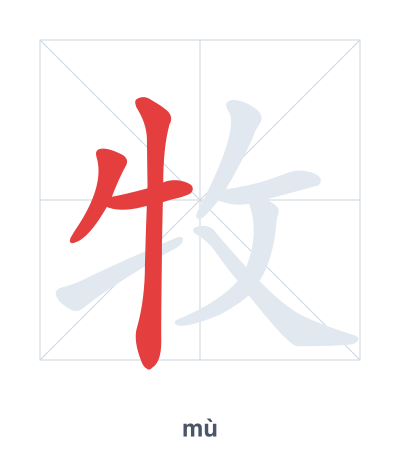
Open Hanzi Writer to see the animated stroke order and practice writing 牧 with real-time feedback.
The character 牧 (mù) is written with 8 strokes. Follow the standard Chinese stroke order: top to bottom, left to right, outside before inside. The radical 牛 is one of its key components.
Practice the correct stroke order with the Hanzi Writer app to see animated stroke-by-stroke guidance with real-time feedback.
牧 means to herd; to pasture.
As an HSK Level 7 character, 牧 is an intermediate-level character.
牧 is a compound character combining the radical 牛 (ox/cow) with 攵 (a hand holding a stick), depicting the act of driving cattle with a rod. Originally, the character showed a hand with a whip or stick herding an ox, which has evolved into the simplified modern form.
💡 Memory Tip: Imagine a farmer poking a stubborn cow (牛) with a stick (攵) to move it to the pasture.
牧场里有很多牛。
mù chǎng lǐ yǒu hěn duō niú
There are many cattle in the pasture.
牧羊人在山上。
mù yáng rén zài shān shàng
The shepherd is on the mountain.
他们过著游牧生活。
tā men guò zhù yóu mù shēng huó
They lead a nomadic life.
Open Hanzi Writer to see the animated stroke order and practice writing 牧 with real-time feedback.
✨ Animated stroke order · Handwriting recognition · HSK-graded practice · Free to use
牧 is made of two parts: the left side is 牛 (niú, meaning 'cow') and the right side is 攵 (pū, a hand holding a stick). Together they show a person using a stick to guide or herd a cow, which gives the character its meaning of 'to herd' or 'to pasture.'