牦 (máo) means "yak" in Chinese. It has 8 strokes with the radical 牛.
Rated 3.7/5 in difficulty (challenging).
Appears in 3+ common words including 牦牛 (máo niú), 牦牛奶 (máo niú nǎi), 牦牛毛 (máo niú máo).
Due to its 8 strokes, Hanzi Writer's error detection shows 牦 requires focused practice — most learners need 10+ attempts for consistent accuracy.
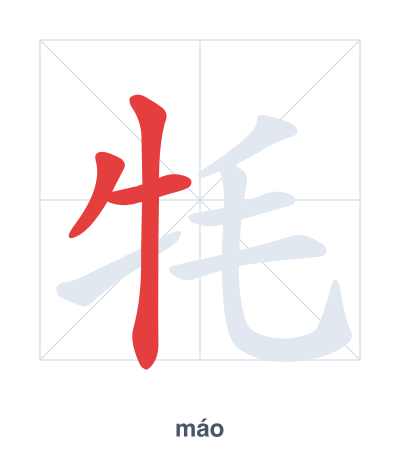
Open Hanzi Writer to see the animated stroke order and practice writing 牦 with real-time feedback.
The character 牦 (máo) is written with 8 strokes. Follow the standard Chinese stroke order: top to bottom, left to right, outside before inside. The radical 牛 is one of its key components.
Practice the correct stroke order with the Hanzi Writer app to see animated stroke-by-stroke guidance with real-time feedback.
牦 means yak.
| Character | 牦 |
| Pinyin | máo (mao) |
| Meaning | yak |
| Strokes | 8 |
| Radical | 牛 |
| Difficulty | 3.7/5 |
牦 is a compound character: the left side is 牛 (ox, the animal radical), and the right side is 毛 (hair/fur), which gives the pronunciation and hints at the yak's famously long, shaggy coat.
💡 Memory Tip: Imagine a yak (牛) so covered in thick, flowing hair (毛) that it looks like a walking fur blanket.
牦牛生活在高原。
máo niú shēng huó zài gāo yuán
Yaks live on plateaus.
牦牛奶营养很高。
máo niú nǎi yíng yǎng hěn gāo
Yak milk is very nutritious.
这是牦牛毛做的。
zhè shì máo niú máo zuò de
This is made of yak hair.
Open Hanzi Writer to see the animated stroke order and practice writing 牦 with real-time feedback.
✨ Animated stroke order · Handwriting recognition · HSK-graded practice · Free to use
The character 牦 is composed of the radical 牛 (cow/ox) on the left and the component 毛 (hair/fur) on the right. Since a yak is a long-haired ox, the left part shows the animal type and the right part suggests its hairy coat.