牡 (mǔ) means "male (of animals)" in Chinese. It has 7 strokes with the radical 牛, and is HSK Level 7.
Rated 3.5/5 in difficulty (challenging).
Harder than 20% of HSK Level 7 characters.
Appears in 3+ common words including 牡丹 (mǔ dān), 牡蛎 (mǔ lì), 牡牛 (mǔ niú).
Due to its 7 strokes, Hanzi Writer's error detection shows 牡 requires focused practice — most learners need 10+ attempts for consistent accuracy.
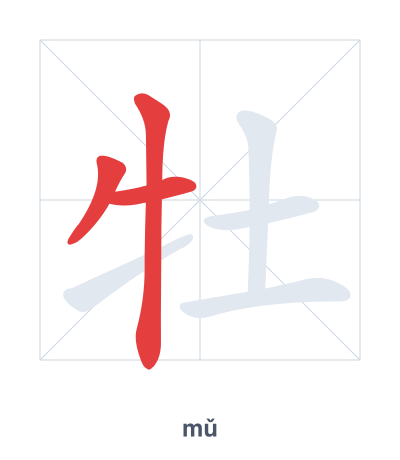
Open Hanzi Writer to see the animated stroke order and practice writing 牡 with real-time feedback.
The character 牡 (mǔ) is written with 7 strokes. Follow the standard Chinese stroke order: top to bottom, left to right, outside before inside. The radical 牛 is one of its key components.
Practice the correct stroke order with the Hanzi Writer app to see animated stroke-by-stroke guidance with real-time feedback.
牡 means male (of animals).
As an HSK Level 7 character, 牡 is an intermediate-level character.
牝 is a compound character: the left side 牜 (a variant of 牛, ox/cow) indicates the animal, and the right side 土 (earth) originally depicted a male sex organ in ancient scripts, together forming the meaning 'male (of animals)'.
💡 Memory Tip: Picture a proud male ox (牜) standing on a mound of earth (土) displaying its masculinity.
牡丹花很漂亮。
mǔ dān huā hěn piào liàng
Peonies are very beautiful.
他喜欢吃牡蛎。
tā xǐ huān chī mǔ lì
He likes eating oysters.
那是一头牡牛。
nà shì yī tóu mǔ niú
That is a bull.
Open Hanzi Writer to see the animated stroke order and practice writing 牡 with real-time feedback.
✨ Animated stroke order · Handwriting recognition · HSK-graded practice · Free to use
The left side is the radical 牛 (cow or ox), which signals that the character relates to animals. The right side is 土 (earth), which originally acted as a phonetic component. Together, they form a character that specifically means 'male of animals'.