甚 (shèn) means "very; extremely; what" in Chinese. It has 9 strokes with the radical 甘, and is HSK Level 4.
Rated 4/5 in difficulty (challenging).
Harder than 62% of HSK Level 4 characters.
Appears in 3+ common words including 甚至 (shèn zhì), 甚好 (shèn hǎo), 甚少 (shèn shǎo).
Due to its 9 strokes, Hanzi Writer's error detection shows 甚 requires focused practice — most learners need 10+ attempts for consistent accuracy.
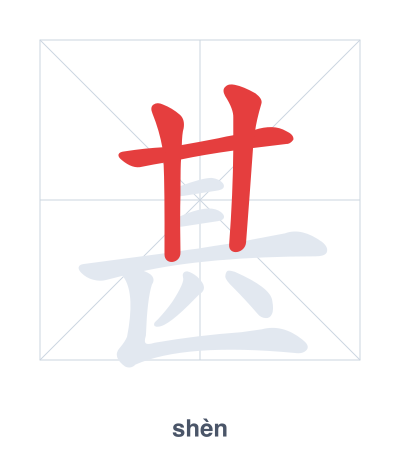
Open Hanzi Writer to see the animated stroke order and practice writing 甚 with real-time feedback.
The character 甚 (shèn) is written with 9 strokes. Follow the standard Chinese stroke order: top to bottom, left to right, outside before inside. The radical 甘 is one of its key components.
Practice the correct stroke order with the Hanzi Writer app to see animated stroke-by-stroke guidance with real-time feedback.
甚 means very; extremely; what.
As an HSK Level 4 character, 甚 is an intermediate-level character.
Originally depicting a person (匕) indulging in sweetness (甘), 甚 conveys the notion of excess or extreme. Over time it came to mean 'very' or 'extremely', and also used as an interrogative 'what'.
💡 Memory Tip: Imagine a person (the top part, 匕) leaning over a bowl of candy (甘) and exclaiming 'This is extremely sweet!'
他甚至忘了吃饭。
tā shèn zhì wàng le chī fàn
He even forgot to eat.
这个主意甚好。
zhè ge zhǔ yì shèn hǎo
This idea is very good.
他甚少出门。
tā shèn shǎo chū mén
He rarely goes out.
Open Hanzi Writer to see the animated stroke order and practice writing 甚 with real-time feedback.
✨ Animated stroke order · Handwriting recognition · HSK-graded practice · Free to use
The character 甚 combines the radical 甘 (sweet) on top with a lower part that historically suggests something excessive or abundant. Together, they imply 'oversweetness' or 'going beyond', which evolved into meanings like 'very' or 'extremely'. The radical 甘 gives a clue about taste, while the whole character indicates a high degree.