甘 (gān) means "sweet; willing" in Chinese. It has 5 strokes with the radical 甘, and is HSK Level 7.
Rated 2.3/5 in difficulty (moderate).
Harder than 1% of HSK Level 7 characters.
Appears in 3+ common words including 甘心 (gān xīn), 甘甜 (gān tián), 甘愿 (gān yuàn).
Hanzi Writer's stroke validation shows learners typically need 5-8 attempts to write 甘 with correct proportion and order.
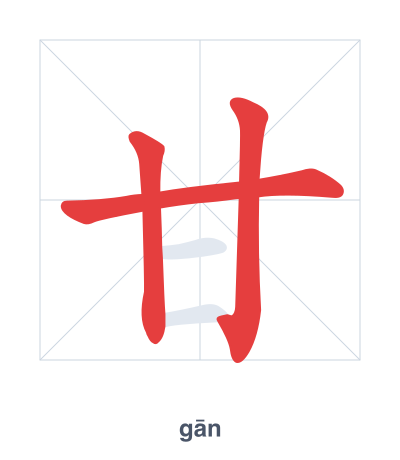
Open Hanzi Writer to see the animated stroke order and practice writing 甘 with real-time feedback.
The character 甘 (gān) is written with 5 strokes. Follow the standard Chinese stroke order: top to bottom, left to right, outside before inside. The radical 甘 is one of its key components.
Practice the correct stroke order with the Hanzi Writer app to see animated stroke-by-stroke guidance with real-time feedback.
甘 means sweet; willing.
As an HSK Level 7 character, 甘 is an intermediate-level character.
The character 甘 is a pictograph of a mouth (口) with something sweet inside, originally depicted as a tongue or a morsel, representing the sensation of sweetness. This visual form directly conveys the meaning of 'sweet,' and the extended sense of 'willing' comes from the idea of voluntarily accepting something pleasant.
💡 Memory Tip: Imagine a mouth (口) with a sweet candy bar (the horizontal line) inside, making you smile as you say '甘, how sweet!'
他不甘心就这样失败。
tā bù gān xīn jiù zhè yàng shī bài
He is not willing to accept failure like this.
这里的泉水很甘甜。
zhè lǐ de quán shuǐ hěn gān tián
The spring water here is sweet and refreshing.
我甘愿为你做任何事。
wǒ gān yuàn wèi nǐ zuò rèn hé shì
I am willing to do anything for you.
Open Hanzi Writer to see the animated stroke order and practice writing 甘 with real-time feedback.
✨ Animated stroke order · Handwriting recognition · HSK-graded practice · Free to use
甘 is a pictographic character that originally depicted something sweet in the mouth. Its shape resembles a mouth (口) with a horizontal line inside, suggesting a tasty morsel held between the lips.