谁 (shéi/shuí) means "Who" in Chinese. It has 10 strokes with the radical 讠, and is HSK Level 1.
Rated 3.4/5 in difficulty (challenging).
Harder than 75% of HSK Level 1 characters.
Appears in 3+ common words including 谁的 (shéi de), 谁家 (shuí jiā), 是谁 (shì shuí).
Due to its 10 strokes, Hanzi Writer's error detection shows 谁 requires focused practice — most learners need 10+ attempts for consistent accuracy.
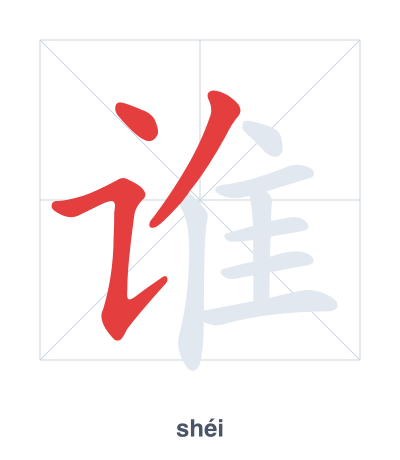
Open Hanzi Writer to see the animated stroke order and practice writing 谁 with real-time feedback.
The character 谁 (shéi/shuí) is written with 10 strokes. Follow the standard Chinese stroke order: top to bottom, left to right, outside before inside. The radical 讠 is one of its key components.
Practice the correct stroke order with the Hanzi Writer app to see animated stroke-by-stroke guidance with real-time feedback.
谁 means Who.
This is a polyphonic character with readings: shéi, shuí.
As an HSK Level 1 character, 谁 is among the first characters beginners learn.
谁 combines the speech radical 讠 (言) with 隹 (a short-tailed bird). The bird component gives a phonetic hint (anciently pronounced closer to *djui), while the speech radical indicates asking a question—'who' is spoken.
💡 Memory Tip: A talking bird (隹) perched on a speech bubble (讠) keeps chirping 'Who? Who?'
这是谁的书包?
zhè shì shéi de shū bāo
Whose schoolbag is this?
你知道这是谁家吗?
nǐ zhī dào zhè shì shuí jiā ma
Do you know whose house this is?
敲门的人是谁?
qiāo mén de rén shì shuí
Who is knocking at the door?
Open Hanzi Writer to see the animated stroke order and practice writing 谁 with real-time feedback.
✨ Animated stroke order · Handwriting recognition · HSK-graded practice · Free to use
谁 is made of two parts: the radical 讠 (speech) on the left, and 隹 (a short-tailed bird) on the right. The speech radical hints that the character is related to asking or speaking, and 隹 provides the pronunciation. Together, they create the question word 'who', used when asking about a person.