晒 (shài) means "to bask in the sun; to dry in the sun" in Chinese. It has 10 strokes with the radical 日, and is HSK Level 4.
Rated 4.2/5 in difficulty (advanced).
Harder than 73% of HSK Level 4 characters.
Appears in 3+ common words including 晒太阳 (shài tài yáng), 晒衣服 (shài yī fú), 晒黑 (shài hēi).
Due to its 10 strokes, Hanzi Writer's error detection shows 晒 requires focused practice — most learners need 10+ attempts for consistent accuracy.
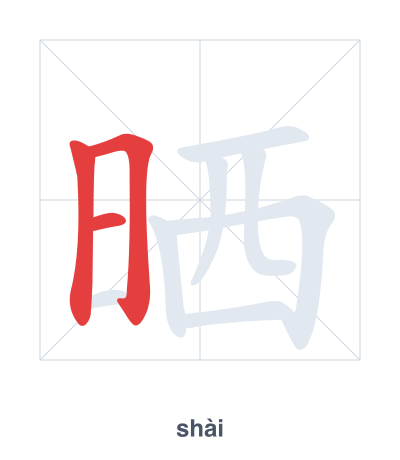
Open Hanzi Writer to see the animated stroke order and practice writing 晒 with real-time feedback.
The character 晒 (shài) is written with 10 strokes. Follow the standard Chinese stroke order: top to bottom, left to right, outside before inside. The radical 日 is one of its key components.
Practice the correct stroke order with the Hanzi Writer app to see animated stroke-by-stroke guidance with real-time feedback.
晒 means to bask in the sun; to dry in the sun.
As an HSK Level 4 character, 晒 is an intermediate-level character.
The character 晒 combines the radical 日 (sun) with 西 (west), suggesting the sun in the west — the afternoon sun used for drying. Historically, 晒 is a simplified form of 曬, where 麗 provided pronunciation; the current form uses 西 both as a phonetic element and to evoke the idea of the sun's position for basking.
💡 Memory Tip: Picture the sun (日) in the west (西) blazing down on clothes spread out on a rack to dry in the afternoon heat.
我们去晒太阳吧。
wǒ men qù shài tài yáng ba
Let's go sunbathe.
妈妈在晒衣服。
mā mā zài shài yī fú
Mom is hanging clothes out to dry.
他被晒黑了。
tā bèi shài hēi le
He got tanned.
Open Hanzi Writer to see the animated stroke order and practice writing 晒 with real-time feedback.
✨ Animated stroke order · Handwriting recognition · HSK-graded practice · Free to use
晒 is made of the radical 日 (sun) on the left, which directly points to sunlight. The right side is 西 (west), but here it mainly acts as a phonetic or visual part. Together, the character conveys the idea of exposing something to the sun's rays.