嫂 (sǎo) means "Sister-in-law (elder brother's wife)." in Chinese. It has 12 strokes with the radical 女, and is HSK Level 7.
Rated 4.2/5 in difficulty (advanced).
Harder than 52% of HSK Level 7 characters.
Appears in 3+ common words including 大嫂 (dà sǎo), 嫂子 (sǎo zi), 表嫂 (biǎo sǎo).
Due to its 12 strokes, Hanzi Writer's error detection shows 嫂 requires focused practice — most learners need 10+ attempts for consistent accuracy.
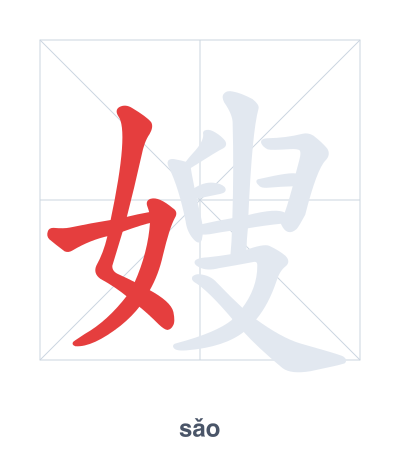
Open Hanzi Writer to see the animated stroke order and practice writing 嫂 with real-time feedback.
The character 嫂 (sǎo) is written with 12 strokes. Follow the standard Chinese stroke order: top to bottom, left to right, outside before inside. The radical 女 is one of its key components.
Practice the correct stroke order with the Hanzi Writer app to see animated stroke-by-stroke guidance with real-time feedback.
嫂 means Sister-in-law (elder brother's wife)..
As an HSK Level 7 character, 嫂 is an intermediate-level character.
嫂 combines the radical 女 (woman) with the phonetic component 叟 (sǒu, meaning 'old man' or 'elder'), indicating an older female relative, specifically the elder brother's wife.
💡 Memory Tip: Picture your older brother's wife (女) serving tea to an old man (叟), making her your 嫂 (sister-in-law).
大嫂正在厨房做饭。
dà sǎo zhèng zài chú fáng zuò fàn
Sister-in-law is cooking in the kitchen.
我嫂子性格很好。
wǒ sǎo zi xìng gé hěn hǎo
My sister-in-law has a great personality.
表嫂送了我一个礼物。
biǎo sǎo sòng le wǒ yí gè lǐ wù
My cousin's wife gave me a gift.
Open Hanzi Writer to see the animated stroke order and practice writing 嫂 with real-time feedback.
✨ Animated stroke order · Handwriting recognition · HSK-graded practice · Free to use
嫂 consists of the radical 女 (woman) on the left and the component 叟 (sǒu, meaning an old man) on the right. The 女 radical indicates that the word refers to a female relative, while 叟 provides the pronunciation and suggests an older person. Together they form 'sister-in-law' – the wife of one's elder brother.