渠 (qú) means "Canal or ditch" in Chinese. It has 11 strokes with the radical 氵, and is HSK Level 6.
Rated 3.9/5 in difficulty (challenging).
Harder than 40% of HSK Level 6 characters.
Appears in 3+ common words including 渠道 (qú dào), 水渠 (shuǐ qú), 沟渠 (gōu qú).
Due to its 11 strokes, Hanzi Writer's error detection shows 渠 requires focused practice — most learners need 10+ attempts for consistent accuracy.
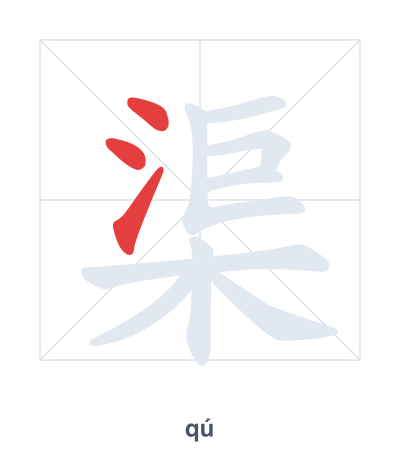
Open Hanzi Writer to see the animated stroke order and practice writing 渠 with real-time feedback.
The character 渠 (qú) is written with 11 strokes. Follow the standard Chinese stroke order: top to bottom, left to right, outside before inside. The radical 氵 is one of its key components.
Practice the correct stroke order with the Hanzi Writer app to see animated stroke-by-stroke guidance with real-time feedback.
渠 means Canal or ditch.
As an HSK Level 6 character, 渠 is an intermediate-level character.
渠 is a phono-semantic compound. The radical 氵 (water) indicates it relates to water channels, while 巨 (jù) provides pronunciation and originally meant 'large', suggesting a large canal or ditch.
💡 Memory Tip: Picture a giant (巨) digging a water (氵) canal.
这是一个新渠道。
zhè shì yí gè xīn qú dào
This is a new channel.
田里有一条水渠。
tián lǐ yǒu yī tiáo shuǐ qú
There is an irrigation canal in the field.
沟渠里有很多水。
gōu qú lǐ yǒu hěn duō shuǐ
There is a lot of water in the ditch.
Open Hanzi Writer to see the animated stroke order and practice writing 渠 with real-time feedback.
✨ Animated stroke order · Handwriting recognition · HSK-graded practice · Free to use
渠 consists of the water radical 氵 on the left and the component 巨 (meaning "huge") on the right, with 木 (wood) sometimes considered inside. The water radical directly links to canals or ditches as water channels, while 巨 suggests a large size, fitting for irrigation canals. Together they create the image of a large man-made waterway.