洄 (huí) means "To swirl; to go against the current." in Chinese. It has 9 strokes with the radical 氵.
Rated 4/5 in difficulty (challenging).
Appears in 3+ common words including 洄游 (huí yóu), 洄水 (huí shuǐ), 洄旋 (huí xuán).
Due to its 9 strokes, Hanzi Writer's error detection shows 洄 requires focused practice — most learners need 10+ attempts for consistent accuracy.
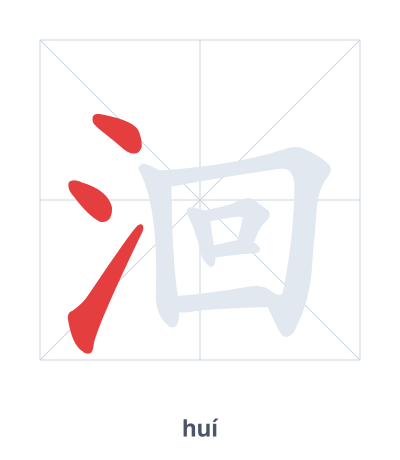
Open Hanzi Writer to see the animated stroke order and practice writing 洄 with real-time feedback.
The character 洄 (huí) is written with 9 strokes. Follow the standard Chinese stroke order: top to bottom, left to right, outside before inside. The radical 氵 is one of its key components.
Practice the correct stroke order with the Hanzi Writer app to see animated stroke-by-stroke guidance with real-time feedback.
洄 means To swirl; to go against the current..
洄 is a compound character with the water radical 氵 and the phonetic component 回 (huí, meaning 'to return' or 'circle'). The character depicts water (氵) moving in a circular or returning motion (回), thus conveying the idea of swirling or going against the current.
💡 Memory Tip: Picture a fish swimming in a circle (回) inside the water (氵), struggling against the current as it swirls back upstream.
鱼儿在水里洄游。
yú ér zài shuǐ lǐ huí yóu
The fish are migrating in the water.
这里有一处洄水。
zhè lǐ yǒu yī chù huí shuǐ
There is an eddy here.
水流在不停地洄旋。
shuǐ liú zài bù tíng dì huí xuán
The water is constantly swirling.
Open Hanzi Writer to see the animated stroke order and practice writing 洄 with real-time feedback.
✨ Animated stroke order · Handwriting recognition · HSK-graded practice · Free to use
洄 is a left-right character with the water radical 氵 on the left and 回 (return, revolve) on the right. The water radical suggests the meaning is related to water, and 回 gives the idea of turning or moving backward, together meaning "to swirl" or "go against the current."