洁 (jié) means "Clean; pure." in Chinese. It has 9 strokes with the radical 氵, and is HSK Level 6.
Rated 4/5 in difficulty (challenging).
Harder than 49% of HSK Level 6 characters.
Appears in 3+ common words including 清洁 (qīng jié), 整洁 (zhěng jié), 洁白 (jié bái).
Due to its 9 strokes, Hanzi Writer's error detection shows 洁 requires focused practice — most learners need 10+ attempts for consistent accuracy.
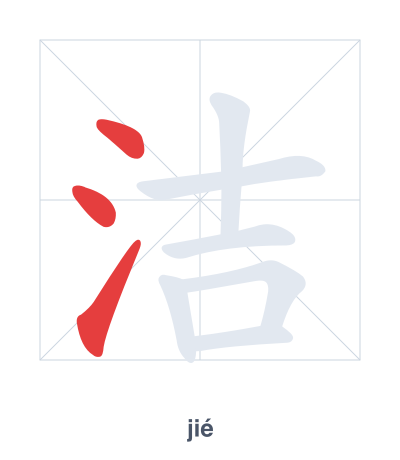
Open Hanzi Writer to see the animated stroke order and practice writing 洁 with real-time feedback.
The character 洁 (jié) is written with 9 strokes. Follow the standard Chinese stroke order: top to bottom, left to right, outside before inside. The radical 氵 is one of its key components.
Practice the correct stroke order with the Hanzi Writer app to see animated stroke-by-stroke guidance with real-time feedback.
洁 means Clean; pure..
As an HSK Level 6 character, 洁 is an intermediate-level character.
The character 洁 combines the water radical 氵 (water) with 吉 (jí, meaning 'lucky' or 'auspicious'). The idea is that clean, pure water is associated with good fortune and purity.
💡 Memory Tip: Imagine washing your hands in pure water (氵) until they sparkle, then receiving a lucky charm (吉) because they are so clean.
教室很清洁。
jiào shì hěn qīng jié
The classroom is very clean.
房间很整洁。
fáng jiān hěn zhěng jié
The room is very neat.
墙壁很洁白。
qiáng bì hěn jié bái
The wall is pure white.
Open Hanzi Writer to see the animated stroke order and practice writing 洁 with real-time feedback.
✨ Animated stroke order · Handwriting recognition · HSK-graded practice · Free to use
洁 is built from the water radical 氵 on the left and the phonetic component 吉 (jí, meaning "auspicious") on the right. Water is naturally associated with washing and cleanliness, so 氵 directly hints at the idea of removing dirt. 吉 adds the sound and, in ancient Chinese thought, purity and cleanliness were considered auspicious qualities.