擎 (qíng) means "to hold up; to lift" in Chinese. It has 16 strokes with the radical 手, and is HSK Level 7.
Rated 4.2/5 in difficulty (advanced).
Harder than 61% of HSK Level 7 characters.
Appears in 3+ common words including 引擎 (yǐn qíng), 擎起 (qíng qǐ), 擎天柱 (qíng tiān zhù).
Due to its 16 strokes, Hanzi Writer's error detection shows 擎 requires focused practice — most learners need 10+ attempts for consistent accuracy.
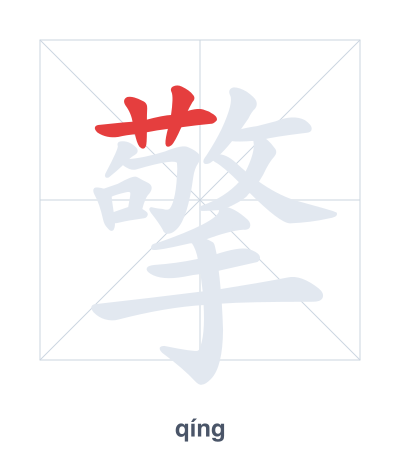
Open Hanzi Writer to see the animated stroke order and practice writing 擎 with real-time feedback.
The character 擎 (qíng) is written with 16 strokes. Follow the standard Chinese stroke order: top to bottom, left to right, outside before inside. The radical 手 is one of its key components.
Practice the correct stroke order with the Hanzi Writer app to see animated stroke-by-stroke guidance with real-time feedback.
擎 means to hold up; to lift.
As an HSK Level 7 character, 擎 is an intermediate-level character.
擎 combines the radical 手 (hand) with 敬 (jìng, respectful), suggesting the action of raising something with reverence—often a banner, torch, or offering. The hand component anchors the meaning of physical lifting, while 敬 adds the nuance of doing so solemnly or carefully.
💡 Memory Tip: Imagine a hand (手) respectfully lifting a heavy bronze 'respect' character (敬) above your head like a trophy.
这辆车的引擎很好。
zhè liàng chē de yǐn qíng hěn hǎo
The engine of this car is very good.
他擎起一面大旗。
tā qíng qǐ yí miàn dà qí
He held up a large flag.
他是家里的擎天柱。
tā shì jiā lǐ de qíng tiān zhù
He is the pillar of the family.
Open Hanzi Writer to see the animated stroke order and practice writing 擎 with real-time feedback.
✨ Animated stroke order · Handwriting recognition · HSK-graded practice · Free to use
擎 contains 手 (hand) on top, which hints at the action of using your hand, and 敬 (jìng, respect) below, which adds a sense of strength or reverence. Together, they create the idea of holding something up with respect or effort.