螓 (qín) means "Small cicada" in Chinese. It has 16 strokes with the radical 虫.
Rated 4.2/5 in difficulty (advanced).
Appears in 3+ common words including 螓首 (qín shǒu), 螓蛾 (qín é), 捉螓 (zhuō qín).
Due to its 16 strokes, Hanzi Writer's error detection shows 螓 requires focused practice — most learners need 10+ attempts for consistent accuracy.
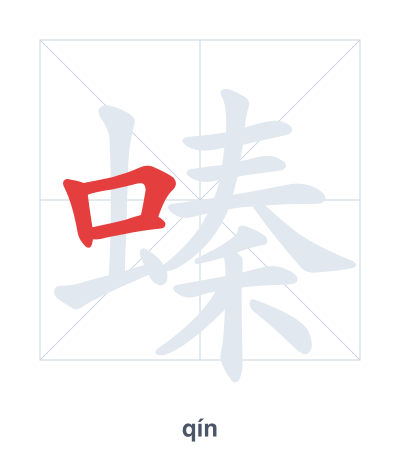
Open Hanzi Writer to see the animated stroke order and practice writing 螓 with real-time feedback.
The character 螓 (qín) is written with 16 strokes. Follow the standard Chinese stroke order: top to bottom, left to right, outside before inside. The radical 虫 is one of its key components.
Practice the correct stroke order with the Hanzi Writer app to see animated stroke-by-stroke guidance with real-time feedback.
螓 means Small cicada.
螓 is a phono-semantic compound combining 虫 (insect) as the meaning component and 秦 (qín) as the phonetic. It refers to a type of small cicada with a narrow head, often mentioned in classical texts.
💡 Memory Tip: Picture a tiny cicada (虫) resting on a Qin dynasty (秦) bronze bell, buzzing a melodic tune.
螓首形容女子美。
qín shǒu xíng róng nǚ zǐ měi
'Qin shou' (cicada-like forehead) describes a woman's beauty.
这种昆虫叫螓蛾。
zhè zhǒng kūn chóng jiào qín é
This insect is called a cicada-moth.
孩子们在外面捉螓。
hái zi men zài wài miàn zhuō qín
The children are catching cicadas outside.
Open Hanzi Writer to see the animated stroke order and practice writing 螓 with real-time feedback.
✨ Animated stroke order · Handwriting recognition · HSK-graded practice · Free to use
螓 combines the radical 虫 (insect) on the left with the phonetic component 秦 (qín) on the right. The radical shows this character is a type of insect, specifically a small cicada. The right side gives the pronunciation but also hints at the cicada's connection to the Qin region in ancient China.