蛾 (é) means "Moth" in Chinese. It has 13 strokes with the radical 虫.
Rated 4.2/5 in difficulty (advanced).
Appears in 3+ common words including 飞蛾 (fēi é), 蛾子 (é zi), 蚕蛾 (cán é).
Due to its 13 strokes, Hanzi Writer's error detection shows 蛾 requires focused practice — most learners need 10+ attempts for consistent accuracy.
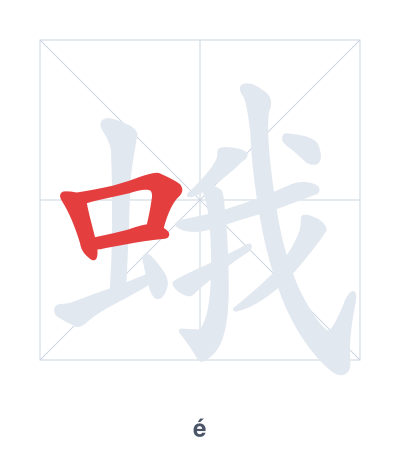
Open Hanzi Writer to see the animated stroke order and practice writing 蛾 with real-time feedback.
The character 蛾 (é) is written with 13 strokes. Follow the standard Chinese stroke order: top to bottom, left to right, outside before inside. The radical 虫 is one of its key components.
Practice the correct stroke order with the Hanzi Writer app to see animated stroke-by-stroke guidance with real-time feedback.
蛾 means Moth.
蛾 is a semantic-phonetic compound. The radical 虫 (insect) indicates it is a type of insect, while 我 (wǒ, meaning 'I' or 'self') provides the pronunciation. Together, the character represents a moth, an insect often drawn to light at night.
💡 Memory Tip: A moth (虫) bumps into a lamp and says, 'I (我) love the light!'
飞蛾喜欢灯光。
fēi é xǐ huān dēng guāng
Moths like light.
墙上有一只蛾子。
qiáng shàng yǒu yī zhī é zi
There is a moth on the wall.
蚕蛾产下了卵。
cán é chǎn xià le luǎn
The silkworm moth has laid eggs.
Open Hanzi Writer to see the animated stroke order and practice writing 蛾 with real-time feedback.
✨ Animated stroke order · Handwriting recognition · HSK-graded practice · Free to use
蛾 has two parts: the left side 虫 (insect radical) and the right side 我 (wǒ, which gives the pronunciation é). The 虫 radical shows that 蛾 refers to an insect, and the right part 我 acts as a phonetic component indicating how to say the character.