虮 (jǐ) means "Nit (louse egg)" in Chinese. It has 8 strokes with the radical 虫.
Rated 3.7/5 in difficulty (challenging).
Appears in 3+ common words including 虮子 (jǐ zi), 虱虮 (shī jǐ), 虮 (jǐ).
Due to its 8 strokes, Hanzi Writer's error detection shows 虮 requires focused practice — most learners need 10+ attempts for consistent accuracy.
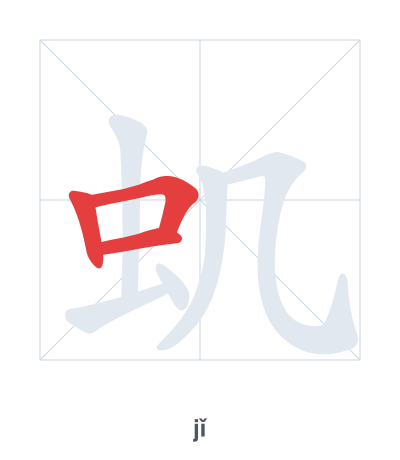
Open Hanzi Writer to see the animated stroke order and practice writing 虮 with real-time feedback.
The character 虮 (jǐ) is written with 8 strokes. Follow the standard Chinese stroke order: top to bottom, left to right, outside before inside. The radical 虫 is one of its key components.
Practice the correct stroke order with the Hanzi Writer app to see animated stroke-by-stroke guidance with real-time feedback.
虮 means Nit (louse egg).
虮 is a phono-semantic compound: the radical 虫 (insect) indicates it relates to bugs, while 几 (jǐ) hints at pronunciation and also visually suggests tiny, numerous dots—like louse eggs clinging to hair.
💡 Memory Tip: Picture a louse egg sitting on a tiny table (几) beside an insect (虫), reminding you that a 'nit' is a louse's egg.
头发上长了虮子。
tóu fà shàng zhǎng le jǐ zi
There are nits in the hair.
我们要消灭虱虮。
wǒ men yào xiāo miè shī jǐ
We need to eliminate lice and nits.
虮是虱子的卵。
jǐ shì shī zi de luǎn
Nits are the eggs of lice.
Open Hanzi Writer to see the animated stroke order and practice writing 虮 with real-time feedback.
✨ Animated stroke order · Handwriting recognition · HSK-graded practice · Free to use
The left component 虫 (chóng) is the insect radical, indicating the character relates to bugs or parasites. The right component 几 (jǐ) provides the pronunciation. Together, 虮 means 'nit' (louse egg), which is an insect-related item.