虺 (huī) means "Venomous snake (ancient term)" in Chinese. It has 9 strokes with the radical 虫.
Rated 4/5 in difficulty (challenging).
Appears in 2+ common words including 虺 (huī), 虺蛇 (huī shé).
Due to its 9 strokes, Hanzi Writer's error detection shows 虺 requires focused practice — most learners need 10+ attempts for consistent accuracy.
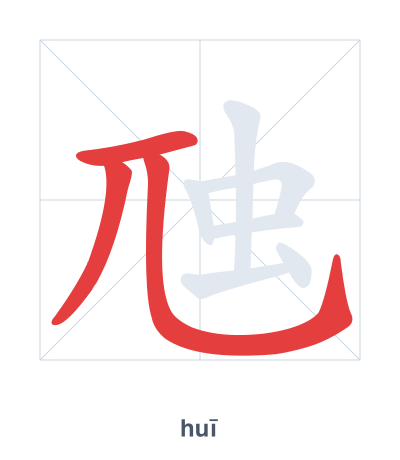
Open Hanzi Writer to see the animated stroke order and practice writing 虺 with real-time feedback.
The character 虺 (huī) is written with 9 strokes. Follow the standard Chinese stroke order: top to bottom, left to right, outside before inside. The radical 虫 is one of its key components.
Practice the correct stroke order with the Hanzi Writer app to see animated stroke-by-stroke guidance with real-time feedback.
虺 means Venomous snake (ancient term).
虺 is a phono-semantic compound: the radical 虫 (snake/insect) hints at its serpentine nature, while 兀 (wù) provides the pronunciation and may suggest a coiled or protruding shape, reminiscent of a snake's head.
💡 Memory Tip: Picture a venomous snake (虫) coiled around a stump (兀), ready to strike with a hiss (huī).
虺是一种古代的蛇。
huī shì yī zhǒng gǔ dài de shé
Hui is a type of ancient snake.
虺蛇在山里生活。
huī shé zài shān lǐ shēng huó
Venomous snakes live in the mountains.
这个字在现代很少用。
zhè ge zì zài xiàn dài hěn shǎo yòng
This character is rarely used in modern times.
Open Hanzi Writer to see the animated stroke order and practice writing 虺 with real-time feedback.
✨ Animated stroke order · Handwriting recognition · HSK-graded practice · Free to use
虺 is composed of the radical 虫 (insect/snake) on the left and the phonetic component 兀 (wù) on the right. The 虫 radical directly indicates the character's association with snakes or reptiles, while 兀 provides pronunciation cues. Together, they form a character that specifically means a venomous snake in ancient Chinese.