虻 (méng) means "Gadfly / Horsefly" in Chinese. It has 9 strokes with the radical 虫.
Rated 4/5 in difficulty (challenging).
Appears in 3+ common words including 牛虻 (niú méng), 虻虫 (méng chóng), 虻蝇 (méng yíng).
Due to its 9 strokes, Hanzi Writer's error detection shows 虻 requires focused practice — most learners need 10+ attempts for consistent accuracy.
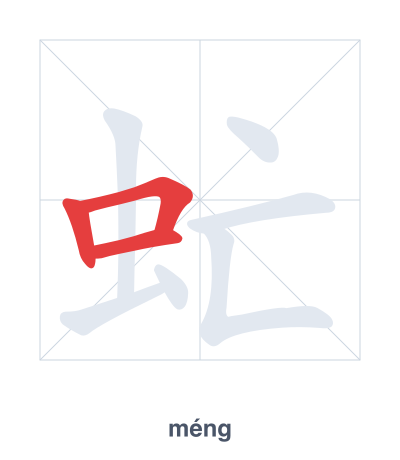
Open Hanzi Writer to see the animated stroke order and practice writing 虻 with real-time feedback.
The character 虻 (méng) is written with 9 strokes. Follow the standard Chinese stroke order: top to bottom, left to right, outside before inside. The radical 虫 is one of its key components.
Practice the correct stroke order with the Hanzi Writer app to see animated stroke-by-stroke guidance with real-time feedback.
虻 means Gadfly / Horsefly.
虻 is a phono-semantic compound: the radical 虫 (chóng, 'insect') indicates it's a type of bug, and the component 亡 (wáng, 'to die') hints at the gadfly's painful, sometimes fatal bite on livestock.
💡 Memory Tip: Imagine a giant horsefly (虫) whose bite is so deadly it makes animals drop dead (亡) on the spot.
这里有一只牛虻。
zhè lǐ yǒu yī zhī niú méng
There is a horsefly here.
虻虫是一种昆虫。
méng chóng shì yī zhǒng kūn chóng
The horsefly is a type of insect.
虻蝇飞走了。
méng yíng fēi zǒu le
The horsefly flew away.
Open Hanzi Writer to see the animated stroke order and practice writing 虻 with real-time feedback.
✨ Animated stroke order · Handwriting recognition · HSK-graded practice · Free to use
虻 is a phono-semantic compound. The left part 虫 (insect) indicates the character relates to bugs, and the right part 亡 (wáng) provides the pronunciation 'méng'. Together, 虫 + 亡 creates the meaning of a horsefly or gadfly, a biting insect.