虬 (qiú) means "Coiled dragon" in Chinese. It has 7 strokes with the radical 虫.
Rated 3.5/5 in difficulty (challenging).
Appears in 3+ common words including 虬龙 (qiú lóng), 虬枝 (qiú zhī), 虬髯 (qiú rán).
Due to its 7 strokes, Hanzi Writer's error detection shows 虬 requires focused practice — most learners need 10+ attempts for consistent accuracy.
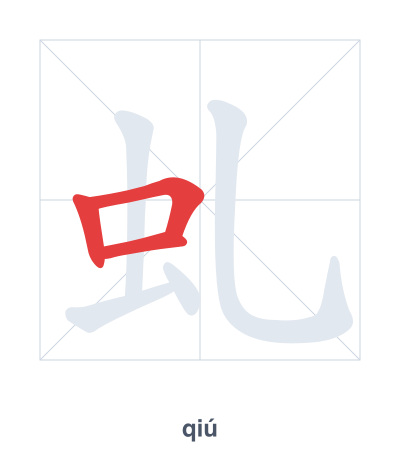
Open Hanzi Writer to see the animated stroke order and practice writing 虬 with real-time feedback.
The character 虬 (qiú) is written with 7 strokes. Follow the standard Chinese stroke order: top to bottom, left to right, outside before inside. The radical 虫 is one of its key components.
Practice the correct stroke order with the Hanzi Writer app to see animated stroke-by-stroke guidance with real-time feedback.
虬 means Coiled dragon.
虬 is a compound character combining the radical 虫 (reptile/insect) with 丩 (jiū, meaning 'entwine' or 'twist') as a phonetic and semantic hint. The 丩 component depicts twisted vines, conveying the coiled, winding body of a dragon, while 虫 classifies it as a mythical reptile.
💡 Memory Tip: Imagine a coiled dragon (虫) with its body twisted like a tangled vine (丩), forming the shape of this character.
虬龙是传说中的龙。
qiú lóng shì chuán shuō zhōng de lóng
The Qiulong is a dragon in legends.
这种树有很多虬枝。
zhè zhòng shù yǒu hěn duō qiú zhī
This tree has many gnarled branches.
他长着一脸虬髯。
tā zhǎng zhe yī liǎn qiú rán
He has a curly beard.
Open Hanzi Writer to see the animated stroke order and practice writing 虬 with real-time feedback.
✨ Animated stroke order · Handwriting recognition · HSK-graded practice · Free to use
The character 虬 has the radical 虫 (insect/reptile) on the left and the component 丩 (which suggests twisting or knotting) on the right. Together, they depict a reptile-like creature that is coiled, representing a coiled dragon.