蜚 (fēi) means "cockroach (component); rumor (component)" in Chinese. It has 14 strokes with the radical 虫.
Rated 4.2/5 in difficulty (advanced).
Appears in 3+ common words including 蜚语 (fēi yǔ), 蜚声 (fēi shēng), 蜚蠊 (fēi lián).
Due to its 14 strokes, Hanzi Writer's error detection shows 蜚 requires focused practice — most learners need 10+ attempts for consistent accuracy.
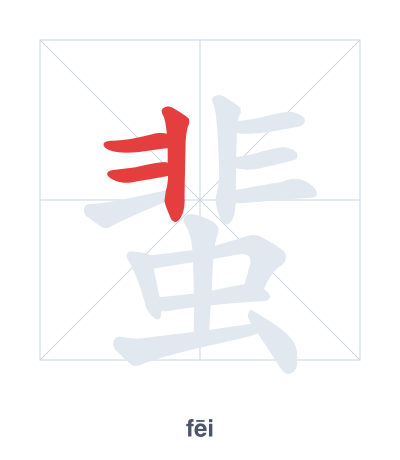
Open Hanzi Writer to see the animated stroke order and practice writing 蜚 with real-time feedback.
The character 蜚 (fēi) is written with 14 strokes. Follow the standard Chinese stroke order: top to bottom, left to right, outside before inside. The radical 虫 is one of its key components.
Practice the correct stroke order with the Hanzi Writer app to see animated stroke-by-stroke guidance with real-time feedback.
蜚 means cockroach (component); rumor (component).
蜚 is a compound character: the radical 虫 ('insect') indicates it relates to bugs, while 非 (fēi) serves as a phonetic component and also suggests negating or spreading—linking to a harmful insect like the cockroach. Historically, 蜚 also came to mean 'rumor' (as in 蜚语) because rumors spread like pests.
💡 Memory Tip: Imagine a cockroach (虫) with two long feelers shaped like the ‘non’ symbol (非), scuttling around spreading nasty rumors.
不要听信流言蜚语。
bú yào tīng xìn liú yán fēi yǔ
Don't listen to rumors and gossip.
他蜚声国际影坛。
tā fēi shēng guó jì yǐng tán
He is renowned in the international film world.
蜚蠊就是蟑螂。
fēi lián jiù shì zhāng láng
Blattaria are cockroaches.
Open Hanzi Writer to see the animated stroke order and practice writing 蜚 with real-time feedback.
✨ Animated stroke order · Handwriting recognition · HSK-graded practice · Free to use
蜚 is composed of the insect radical 虫 on top and 非 (meaning "wrong" or "not") below. The upper component connects to the meaning "cockroach" (an insect), while the lower component 非 gives the pronunciation "fēi" and also suggests something false, linking to the meaning "rumor."