虱 (shī) means "Louse" in Chinese. It has 8 strokes with the radical 虫.
Rated 3.7/5 in difficulty (challenging).
Appears in 3+ common words including 虱子 (shī zi), 木虱 (mù shī), 虱 (shī).
Due to its 8 strokes, Hanzi Writer's error detection shows 虱 requires focused practice — most learners need 10+ attempts for consistent accuracy.
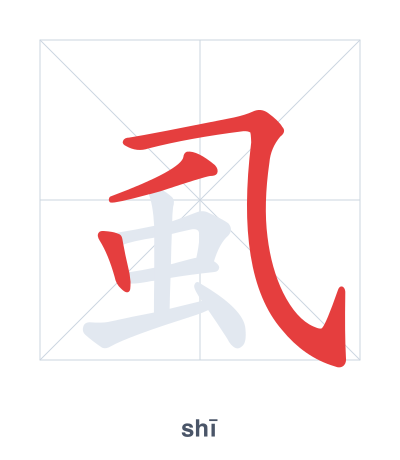
Open Hanzi Writer to see the animated stroke order and practice writing 虱 with real-time feedback.
The character 虱 (shī) is written with 8 strokes. Follow the standard Chinese stroke order: top to bottom, left to right, outside before inside. The radical 虫 is one of its key components.
Practice the correct stroke order with the Hanzi Writer app to see animated stroke-by-stroke guidance with real-time feedback.
虱 means Louse.
The character 虱 combines the radical 虫 (insect) with 卂, an ancient pictograph that originally depicted a louse clinging to a piece of fabric, indicating a parasitic insect that infests hair and clothing.
💡 Memory Tip: Picture the top squiggly shape as a louse with tiny legs crawling on the insect radical (虫) below, reminding you that 虱 itself is that pesky louse.
狗身上有很多虱子。
gǒu shēn shàng yǒu hěn duō shī zi
The dog has many lice.
木头里发现了木虱。
mù tou lǐ fā xiàn le mù shī
Woodlice were found in the wood.
虱子会让人觉得痒。
shī zi huì ràng rén jué de yǎng
Lice make people feel itchy.
Open Hanzi Writer to see the animated stroke order and practice writing 虱 with real-time feedback.
✨ Animated stroke order · Handwriting recognition · HSK-graded practice · Free to use
虱 is composed of the radical 虫 (insect) on the left and the phonetic component 丂 (an old form meaning "wind") on the right. The radical hints that a louse is a type of insect, while the right side originally suggested the insect's ability to cling or move quickly. This combination makes 虱 mean "louse."