窍 (qiào) means "An aperture, hole, or the key to a problem." in Chinese. It has 10 strokes with the radical 穴, and is HSK Level 7.
Rated 4.2/5 in difficulty (advanced).
Harder than 77% of HSK Level 7 characters.
Appears in 3+ common words including 窍门 (qiào mén), 开窍 (kāi qiào), 一窍不通 (yī qiào bù tōng).
Due to its 10 strokes, Hanzi Writer's error detection shows 窍 requires focused practice — most learners need 10+ attempts for consistent accuracy.
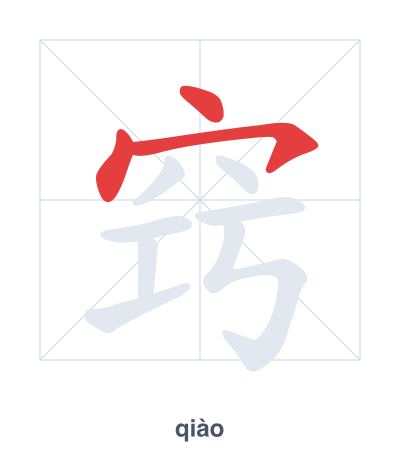
Open Hanzi Writer to see the animated stroke order and practice writing 窍 with real-time feedback.
The character 窍 (qiào) is written with 10 strokes. Follow the standard Chinese stroke order: top to bottom, left to right, outside before inside. The radical 穴 is one of its key components.
Practice the correct stroke order with the Hanzi Writer app to see animated stroke-by-stroke guidance with real-time feedback.
窍 means An aperture, hole, or the key to a problem..
As an HSK Level 7 character, 窍 is an intermediate-level character.
窍 combines the radical 穴 (a cave or hole) with 巧 (skillful, clever), suggesting a cleverly made opening or the 'key' that unlocks understanding. The character originally referred to bodily orifices, like the seven apertures of the head, and later extended to mean the crucial point or trick to solve a problem.
💡 Memory Tip: Imagine a clever fox (巧) digging a tiny escape hole (穴) that becomes the key to getting out of a tricky trap.
学习有窍门。
xué xí yǒu qiào mén
There are tricks to learning.
他终于开窍了。
tā zhōng yú kāi qiào le
He finally understood.
我对他一窍不通。
wǒ duì tā yī qiào bù tōng
I don't understand him at all.
Open Hanzi Writer to see the animated stroke order and practice writing 窍 with real-time feedback.
✨ Animated stroke order · Handwriting recognition · HSK-graded practice · Free to use
窍 combines the radical 穴 (cave) on top and the phonetic component 巧 (qiǎo, clever) below. The radical 穴 suggests a hole or opening, while 巧 hints at cleverness, together meaning a key opening or clever solution.