权 (quán) means "Power; right" in Chinese. It has 6 strokes with the radical 木, and is HSK Level 4.
Rated 3.2/5 in difficulty (challenging).
Harder than 22% of HSK Level 4 characters.
Appears in 3+ common words including 权利 (quán lì), 权力 (quán lì), 授权 (shòu quán).
Due to its 6 strokes, Hanzi Writer's error detection shows 权 requires focused practice — most learners need 10+ attempts for consistent accuracy.
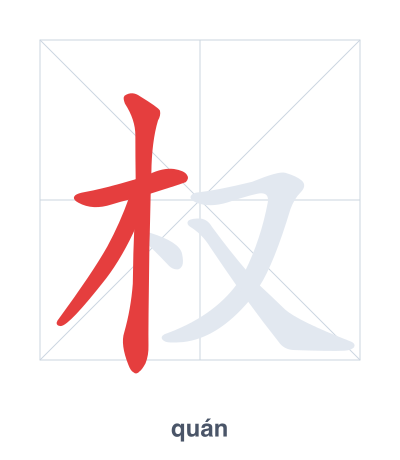
Open Hanzi Writer to see the animated stroke order and practice writing 权 with real-time feedback.
The character 权 (quán) is written with 6 strokes. Follow the standard Chinese stroke order: top to bottom, left to right, outside before inside. The radical 木 is one of its key components.
Practice the correct stroke order with the Hanzi Writer app to see animated stroke-by-stroke guidance with real-time feedback.
权 means Power; right.
As an HSK Level 4 character, 权 is an intermediate-level character.
The character 权 is the simplified form of 權, originally depicting a wooden steelyard (木) used for weighing, with 又 (right hand) indicating the hand that adjusts the weight. This visual of balancing goods evolved to mean 'weight,' 'authority,' and 'right'—the power to judge or decide.
💡 Memory Tip: Picture a hand (又) raising a wooden gavel (木) to assert authority and power.
每个人都有权利。
měi gè rén dōu yǒu quán lì
Everyone has rights.
他很有权力。
tā hěn yǒu quán lì
He has a lot of power.
我得到了授权。
wǒ dé dào le shòu quán
I have been authorized.
Open Hanzi Writer to see the animated stroke order and practice writing 权 with real-time feedback.
✨ Animated stroke order · Handwriting recognition · HSK-graded practice · Free to use
权 is composed of the radical 木 (wood/tree) on the left and the component 又 (hand) on the right. Together, they suggest a wooden object held by a hand — historically a scale made of wood used for weighing, which connects to the ideas of measuring, balancing, and thus power or rights.