Hanzi Writer

How to Write 磨 (mó/mò) — Meaning “grind / polish”

/ HSK Level 6 16 strokes Radical: 石

磨 (mó/mò) means "grind / polish" in Chinese. It has 16 strokes with the radical 石, and is HSK Level 6.

Rated 4.2/5 in difficulty (advanced).

Harder than 81% of HSK Level 6 characters.

Appears in 4+ common words including 磨刀 (mó dāo), 磨练 (mó liàn), 石磨 (shí mò).

Due to its 16 strokes, Hanzi Writer's error detection shows 磨 requires focused practice — most learners need 10+ attempts for consistent accuracy.
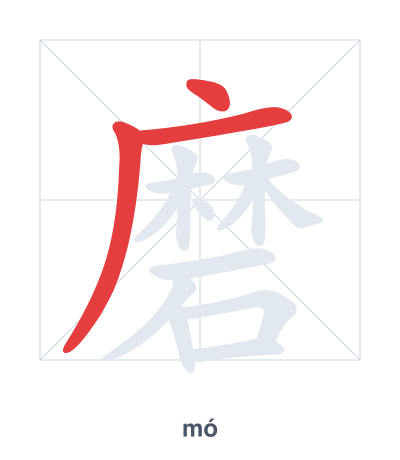
Stroke order practice for 磨 - mó/mò

Practice Writing 磨 (mó/mò)

Open Hanzi Writer to see the animated stroke order and practice writing 磨 with real-time feedback.

The character (mó/mò) is written with 16 strokes. Follow the standard Chinese stroke order: top to bottom, left to right, outside before inside. The radical is one of its key components.

Practice the correct stroke order with the Hanzi Writer app to see animated stroke-by-stroke guidance with real-time feedback.

means grind / polish.

This is a polyphonic character with readings: mó, mò.

As an HSK Level 6 character, is an intermediate-level character.

Character
Pinyinmó / mò (mo)
Meaninggrind / polish
Strokes16
Radical
HSK Level6
Difficulty4.2/5

磨 is a compound character where 石 (stone) is the semantic component, indicating a tool used for grinding, and 麻 (hemp) provides phonetic cues. Together, they evoke the action of rubbing a stone against a surface to polish or grind it, as ancient grindstones were often paired with fibrous materials.

💡 Memory Tip: Picture a stone (石) pressed against a coarse hemp cloth (麻) as you slide them together to grind and polish a surface.

mó dāo
sharpen a knife
mó liàn
To temper, discipline, or train oneself through hardship.
shí mò
Stone mill or grindstone.
mò pán
Millstone.

爷爷正在院子里认真地磨刀,准备宰鸡。

yé yé zhèng zài yuàn zi lǐ rèn zhēn dì mó dāo zhǔn bèi zǎi jī

Grandpa is carefully sharpening a knife in the yard, preparing to slaughter a chicken.

艰苦的环境可以磨练一个人的坚强意志。

jiān kǔ de huán jìng kě yǐ mó liàn yí gè rén de jiān qiáng yì zhì

A harsh environment can temper a person's strong will.

过去农村常用石磨来加工面粉和豆浆。

guò qù nóng cūn cháng yòng shí mò lái jiā gōng miàn fěn hé dòu jiāng

In the past, stone mills were commonly used in rural areas to process flour and soy milk.

那个沉重的磨盘被拉磨的小驴拉得飞转。

nà ge chén zhòng de mò pán bèi lā mó de xiǎo lǘ lā dé fēi zhuàn

The heavy millstone was spun rapidly by the little donkey.

Character Pinyin Strokes Radical
(current) mó / mò 16
dié 14
dú / zhóu 14
jié 14
Stroke order practice for 磨 - mó/mò

Practice Writing 磨 (mó/mò)

Open Hanzi Writer to see the animated stroke order and practice writing 磨 with real-time feedback.

✨ Animated stroke order · Handwriting recognition · HSK-graded practice · Free to use

Frequently Asked Questions about 磨

磨 consists of 麻 (hemp) on top and 石 (stone) below. The stone radical indicates the action involves a hard surface, while 麻 may suggest the rough texture or the process of rubbing, together meaning to grind or polish.

More HSK Level 6 Characters

Characters with Radical 石

Other 16-Stroke Characters