碣 (jié) means "Stone tablet / Stone pillar" in Chinese. It has 14 strokes with the radical 石.
Rated 4.2/5 in difficulty (advanced).
Appears in 3+ common words including 石碣 (shí jié), 碣石 (jié shí), 碑碣 (bēi jié).
Due to its 14 strokes, Hanzi Writer's error detection shows 碣 requires focused practice — most learners need 10+ attempts for consistent accuracy.
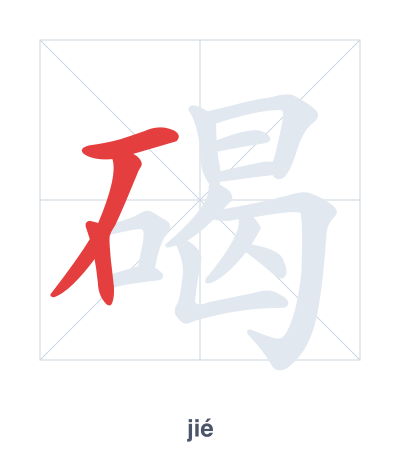
Open Hanzi Writer to see the animated stroke order and practice writing 碣 with real-time feedback.
The character 碣 (jié) is written with 14 strokes. Follow the standard Chinese stroke order: top to bottom, left to right, outside before inside. The radical 石 is one of its key components.
Practice the correct stroke order with the Hanzi Writer app to see animated stroke-by-stroke guidance with real-time feedback.
碣 means Stone tablet / Stone pillar.
碣 is a phono-semantic compound. The radical 石 (stone) indicates it is made of stone, while 曷 (hé) suggests the pronunciation. Ancient stone tablets or pillars were used for inscriptions or monuments.
💡 Memory Tip: Picture a stone pillar (石) under the sun (日) with a person (人) asking 'What (曷) does this inscription say?'
山上有一块石碣。
shān shàng yǒu yī kuài shí jié
There is a stone tablet on the mountain.
曹操写过《观沧海》碣石。
cáo cāo xiě guò guān cāng hǎi jié shí
Cao Cao wrote 'Viewing the Blue Sea' at Mount Jieshi.
这里的碑碣很有历史。
zhè lǐ de bēi jié hěn yǒu lì shǐ
The stone tablets here have a long history.
Open Hanzi Writer to see the animated stroke order and practice writing 碣 with real-time feedback.
✨ Animated stroke order · Handwriting recognition · HSK-graded practice · Free to use
The left side is 石 (shí), meaning 'stone', which directly connects to the character's meaning of a stone tablet or pillar. The right side is 曷 (hé), which provides the pronunciation and was originally a phonetic component, though its own meaning does not relate to stone.