谬 (miù) means "mistake; error; false" in Chinese. It has 13 strokes with the radical 讠, and is HSK Level 7.
Rated 3.9/5 in difficulty (challenging).
Harder than 37% of HSK Level 7 characters.
Appears in 3+ common words including 荒谬 (huāng miù), 谬论 (miù lùn), 谬误 (miù wù).
Due to its 13 strokes, Hanzi Writer's error detection shows 谬 requires focused practice — most learners need 10+ attempts for consistent accuracy.
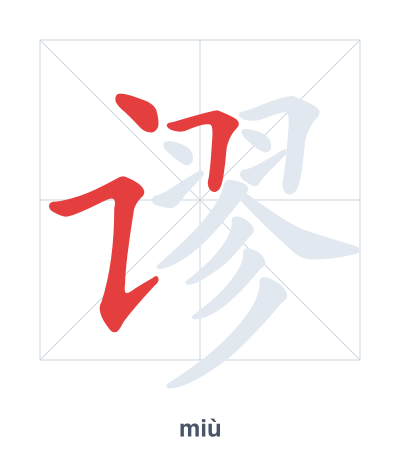
Open Hanzi Writer to see the animated stroke order and practice writing 谬 with real-time feedback.
The character 谬 (miù) is written with 13 strokes. Follow the standard Chinese stroke order: top to bottom, left to right, outside before inside. The radical 讠 is one of its key components.
Practice the correct stroke order with the Hanzi Writer app to see animated stroke-by-stroke guidance with real-time feedback.
谬 means mistake; error; false.
As an HSK Level 7 character, 谬 is an intermediate-level character.
The character 谬 combines the speech radical 讠 (words) with 翏, a component originally depicting a bird flying high. Together, they evoke the image of words that 'fly off course' from the truth, representing error or falsehood.
💡 Memory Tip: Picture a bird (翏) squawking wild lies from its beak (讠), causing a terrible mistake.
这个想法很荒谬。
zhè ge xiǎng fǎ hěn huāng miù
This idea is very absurd.
这是一个明显的谬论。
zhè shì yí gè míng xiǎn de miù lùn
This is an obvious fallacy.
书中有很多谬误。
shū zhōng yǒu hěn duō miù wù
There are many errors in the book.
Open Hanzi Writer to see the animated stroke order and practice writing 谬 with real-time feedback.
✨ Animated stroke order · Handwriting recognition · HSK-graded practice · Free to use
谬 consists of the radical 讠 (speech) on the left and the component 翏 on the right. The radical hints that the character relates to spoken words or language, while 翏 suggests something twisted or tangled. Combined, they imply "speech that is twisted" — leading to the meaning of mistake, error, or falsehood.