谍 (dié) means "spy or intelligence" in Chinese. It has 11 strokes with the radical 讠, and is HSK Level 7.
Rated 3.9/5 in difficulty (challenging).
Harder than 36% of HSK Level 7 characters.
Appears in 3+ common words including 间谍 (jiàn dié), 谍战 (dié zhàn), 谍报 (dié bào).
Due to its 11 strokes, Hanzi Writer's error detection shows 谍 requires focused practice — most learners need 10+ attempts for consistent accuracy.
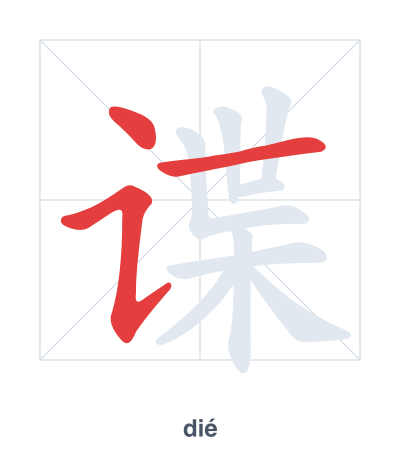
Open Hanzi Writer to see the animated stroke order and practice writing 谍 with real-time feedback.
The character 谍 (dié) is written with 11 strokes. Follow the standard Chinese stroke order: top to bottom, left to right, outside before inside. The radical 讠 is one of its key components.
Practice the correct stroke order with the Hanzi Writer app to see animated stroke-by-stroke guidance with real-time feedback.
谍 means spy or intelligence.
As an HSK Level 7 character, 谍 is an intermediate-level character.
谍 is a phono-semantic compound: the radical 讠 (speech) hints at information exchange, while 枼 (yè, leaf or thin tablet) provides the pronunciation and suggests the thin bamboo slips once used for secret messages. Together, they evoke the idea of covert communication or intelligence gathering.
💡 Memory Tip: Picture a spy whispering (讠) behind a large leaf (枼) to pass secret intelligence.
他是一个间谍。
tā shì yí gè jiàn dié
He is a spy.
这部谍战剧很好看。
zhè bù dié zhàn jù hěn hǎo kàn
This spy drama is very good.
谍报工作很危险。
dié bào gōng zuò hěn wēi xiǎn
Intelligence work is very dangerous.
Open Hanzi Writer to see the animated stroke order and practice writing 谍 with real-time feedback.
✨ Animated stroke order · Handwriting recognition · HSK-graded practice · Free to use
The character 谍 is composed of the radical 讠 (speech) on the left and the phonetic component 枼 (yè) on the right. The speech radical suggests that spying involves words, reports, or communication. The right side gives the character its pronunciation dié.