眠 (mián) means "sleep; dormancy" in Chinese. It has 10 strokes with the radical 目, and is HSK Level 5.
Rated 4.2/5 in difficulty (advanced).
Harder than 83% of HSK Level 5 characters.
Appears in 3+ common words including 睡眠 (shuì mián), 失眠 (shī mián), 冬眠 (dōng mián).
Due to its 10 strokes, Hanzi Writer's error detection shows 眠 requires focused practice — most learners need 10+ attempts for consistent accuracy.
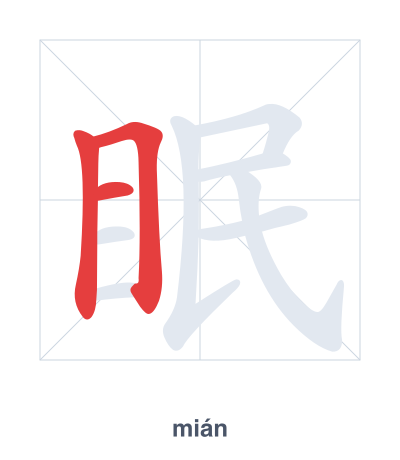
Open Hanzi Writer to see the animated stroke order and practice writing 眠 with real-time feedback.
The character 眠 (mián) is written with 10 strokes. Follow the standard Chinese stroke order: top to bottom, left to right, outside before inside. The radical 目 is one of its key components.
Practice the correct stroke order with the Hanzi Writer app to see animated stroke-by-stroke guidance with real-time feedback.
眠 means sleep; dormancy.
As an HSK Level 5 character, 眠 is an intermediate-level character.
眠 combines the radical 目 (eye) with 民 (people), which provides the phonetic component. It originally depicted the act of closing one's eyes to sleep, with the eye radical directly linking to the meaning of sleep.
💡 Memory Tip: Picture your eyes (目) as little people (民) who are all tucked in and fast asleep.
他的睡眠质量很好。
tā de shuì mián zhì liàng hěn hǎo
His sleep quality is very good.
我昨晚失眠了。
wǒ zuó wǎn shī mián le
I had insomnia last night.
熊在冬天会冬眠。
xióng zài dōng tiān huì dōng mián
Bears hibernate in winter.
Open Hanzi Writer to see the animated stroke order and practice writing 眠 with real-time feedback.
✨ Animated stroke order · Handwriting recognition · HSK-graded practice · Free to use
眠 is composed of the radical 目 (eye) on the left and the phonetic component 民 (mín, people) on the right. The eye radical indicates that the character relates to vision or eye activity, while the whole character means 'sleep' — when you sleep, your eyes are closed. This structure shows that sleep is associated with the eyes being shut.