蛐 (qū) means "cricket" in Chinese. It has 12 strokes with the radical 虫.
Rated 4.2/5 in difficulty (advanced).
Appears in 3+ common words including 蛐蛐 (qū qū), 蛐蛐叫 (qū qū jiào), 斗蛐蛐 (dòu qū qū).
Due to its 12 strokes, Hanzi Writer's error detection shows 蛐 requires focused practice — most learners need 10+ attempts for consistent accuracy.
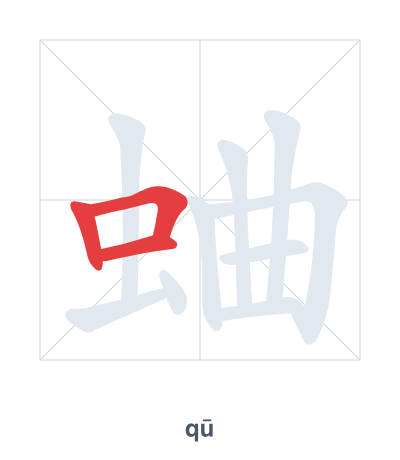
Open Hanzi Writer to see the animated stroke order and practice writing 蛐 with real-time feedback.
The character 蛐 (qū) is written with 12 strokes. Follow the standard Chinese stroke order: top to bottom, left to right, outside before inside. The radical 虫 is one of its key components.
Practice the correct stroke order with the Hanzi Writer app to see animated stroke-by-stroke guidance with real-time feedback.
蛐 means cricket.
蛐 is a phono-semantic compound: the radical 虫 (insect) indicates it's a type of bug, while 曲 (qū, meaning 'curved' and also onomatopoeic for the cricket's chirp) supplies the sound and hints at the insect's arched body.
💡 Memory Tip: Picture a cricket with a curved back (曲) chirping 'qu-qu' as it hides under a leaf.
我在草丛里抓蛐蛐。
wǒ zài cǎo cóng lǐ zhuā qū qū
I am catching crickets in the grass.
晚上的蛐蛐叫声很大。
wǎn shàng de qū qū jiào shēng hěn dà
The crickets chirp loudly at night.
爷爷喜欢斗蛐蛐。
yé yé xǐ huān dòu qū qū
Grandpa likes cricket fighting.
Open Hanzi Writer to see the animated stroke order and practice writing 蛐 with real-time feedback.
✨ Animated stroke order · Handwriting recognition · HSK-graded practice · Free to use
The character 蛐 is made of two parts: the left radical 虫 (insect) and the right part 曲 (qū, which means curved or bent). The radical tells you that a cricket is a type of insect, while 曲 gives the pronunciation and also suggests the curved shape of a cricket's body or the sound it makes.