蛔 (huí) means "roundworm" in Chinese. It has 12 strokes with the radical 虫.
Rated 4.2/5 in difficulty (advanced).
Appears in 3+ common words including 蛔虫 (huí chóng), 蛔虫药 (huí chóng yào), 治蛔虫 (zhì huí chóng).
Due to its 12 strokes, Hanzi Writer's error detection shows 蛔 requires focused practice — most learners need 10+ attempts for consistent accuracy.
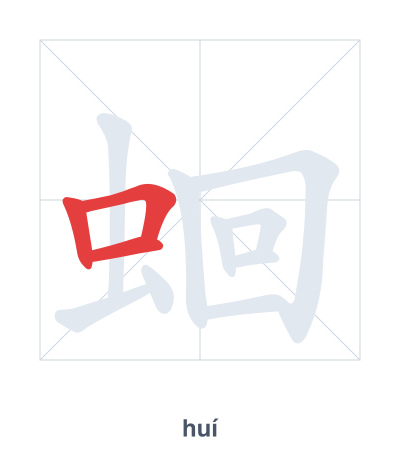
Open Hanzi Writer to see the animated stroke order and practice writing 蛔 with real-time feedback.
The character 蛔 (huí) is written with 12 strokes. Follow the standard Chinese stroke order: top to bottom, left to right, outside before inside. The radical 虫 is one of its key components.
Practice the correct stroke order with the Hanzi Writer app to see animated stroke-by-stroke guidance with real-time feedback.
蛔 means roundworm.
蛔 is a phono-semantic compound: the radical 虫 (insect/worm) indicates its biological category, while 回 (huí, meaning 'return' or 'circle') hints at the roundworm's round shape and its curling, looping movements inside the intestines.
💡 Memory Tip: Picture a roundworm curling into a perfect circle (回) inside a stomach (虫), wriggling back to where it started.
肚子里可能有蛔虫。
dǔ zi lǐ kě néng yǒu huí chóng
There might be roundworms in the stomach.
医生开了蛔虫药。
yī shēng kāi le huí chóng yào
The doctor prescribed medicine for roundworms.
吃这种药可以治蛔虫。
chī zhè zhǒng yào kě yǐ zhì huí chóng
Taking this medicine can treat roundworms.
Open Hanzi Writer to see the animated stroke order and practice writing 蛔 with real-time feedback.
✨ Animated stroke order · Handwriting recognition · HSK-graded practice · Free to use
蛔 is a phono-semantic compound. The left component 虫 (insect/worm radical) indicates the meaning relates to worms, while the right component 回 (huí, meaning to return or circle) provides the sound and also suggests the round, curling shape of a roundworm.