蛑 (móu) means "swimming crab" in Chinese. It has 12 strokes with the radical 虫.
Rated 4.2/5 in difficulty (advanced).
Appears in 3+ common words including 蝤蛑 (qiú móu), 抓蛑 (zhuā móu), 蛑壳 (móu ké).
Due to its 12 strokes, Hanzi Writer's error detection shows 蛑 requires focused practice — most learners need 10+ attempts for consistent accuracy.
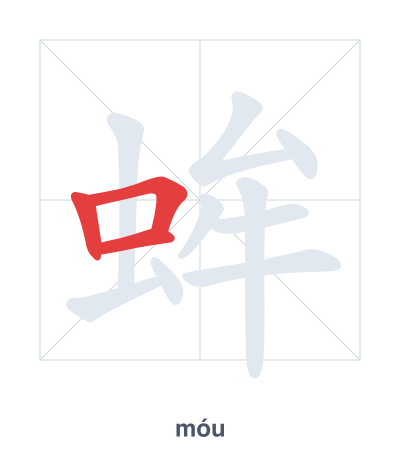
Open Hanzi Writer to see the animated stroke order and practice writing 蛑 with real-time feedback.
The character 蛑 (móu) is written with 12 strokes. Follow the standard Chinese stroke order: top to bottom, left to right, outside before inside. The radical 虫 is one of its key components.
Practice the correct stroke order with the Hanzi Writer app to see animated stroke-by-stroke guidance with real-time feedback.
蛑 means swimming crab.
蛑 is a phono-semantic compound. The radical 虫 (insect/creature) indicates it belongs to the animal kingdom, specifically a swimming crab, while the phonetic component 牟 (móu) provides the pronunciation.
💡 Memory Tip: Picture a swimming crab whose two claws form the top of 牟, clutching the insect radical 虫 as it scuttles sideways through the water.
这种蝤蛑的味道很鲜。
zhè zhǒng qiú móu de wèi dào hěn xiān
This swimming crab tastes very fresh.
我们去海边抓蛑。
wǒ men qù hǎi biān zhuā móu
We are going to the seaside to catch crabs.
蛑壳是非常硬的。
móu ké shì fēi cháng yìng de
Crab shells are very hard.
Open Hanzi Writer to see the animated stroke order and practice writing 蛑 with real-time feedback.
✨ Animated stroke order · Handwriting recognition · HSK-graded practice · Free to use
The character 蛑 is made of the radical 虫 (insect) on the left and the phonetic component 牟 on the right. Since 虫 often represents creatures like insects or shellfish, and 蛑 specifically refers to a swimming crab, the radical hints at its classification as a marine animal.