谜 (mí) means "riddle; puzzle; mystery" in Chinese. It has 11 strokes with the radical 讠, and is HSK Level 7.
Rated 3.9/5 in difficulty (challenging).
Harder than 36% of HSK Level 7 characters.
Appears in 3+ common words including 谜语 (mí yǔ), 谜底 (mí dǐ), 猜谜 (cāi mí).
Due to its 11 strokes, Hanzi Writer's error detection shows 谜 requires focused practice — most learners need 10+ attempts for consistent accuracy.
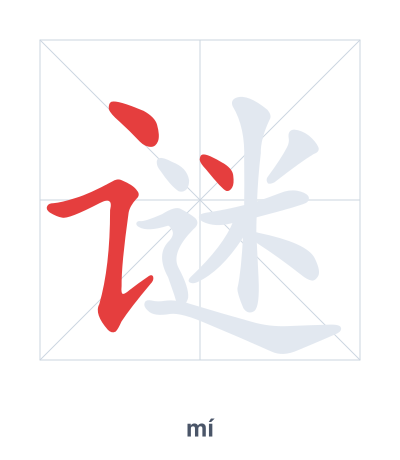
Open Hanzi Writer to see the animated stroke order and practice writing 谜 with real-time feedback.
The character 谜 (mí) is written with 11 strokes. Follow the standard Chinese stroke order: top to bottom, left to right, outside before inside. The radical 讠 is one of its key components.
Practice the correct stroke order with the Hanzi Writer app to see animated stroke-by-stroke guidance with real-time feedback.
谜 means riddle; puzzle; mystery.
As an HSK Level 7 character, 谜 is an intermediate-level character.
谜 combines the speech radical 讠 (words) with 迷 (to be confused or lost), literally meaning 'speech that confuses'—a riddle or puzzle that leads the listener astray with words.
💡 Memory Tip: Imagine a speech bubble (讠) containing a tiny maze (迷) that you must solve to find the answer.
你会猜谜语吗?
nǐ huì cāi mí yǔ ma
Can you solve riddles?
谜底是什么?
mí dǐ shì shén me
What is the answer to the riddle?
我们来猜谜吧。
wǒ men lái cāi mí ba
Let's guess riddles.
Open Hanzi Writer to see the animated stroke order and practice writing 谜 with real-time feedback.
✨ Animated stroke order · Handwriting recognition · HSK-graded practice · Free to use
谜 is made of two parts: the radical 讠 (speech) on the left and 米 (rice) plus 辶 (walk) on the right. The speech radical indicates that a riddle is spoken or written, while the right side hints at something that leads you on a path to find the answer.