底 (dǐ) means "bottom; base" in Chinese. It has 8 strokes with the radical 广, and is HSK Level 3.
Rated 3.7/5 in difficulty (challenging).
Harder than 49% of HSK Level 3 characters.
Appears in 3+ common words including 到底 (dào dǐ), 底下 (dǐ xià), 月底 (yuè dǐ).
Due to its 8 strokes, Hanzi Writer's error detection shows 底 requires focused practice — most learners need 10+ attempts for consistent accuracy.
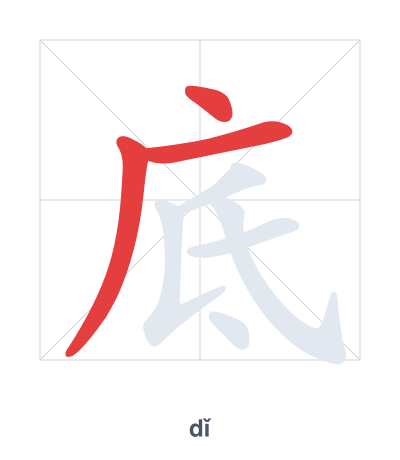
Open Hanzi Writer to see the animated stroke order and practice writing 底 with real-time feedback.
The character 底 (dǐ) is written with 8 strokes. Follow the standard Chinese stroke order: top to bottom, left to right, outside before inside. The radical 广 is one of its key components.
Practice the correct stroke order with the Hanzi Writer app to see animated stroke-by-stroke guidance with real-time feedback.
底 means bottom; base.
As an HSK Level 3 character, 底 is an intermediate-level character.
The character 底 combines the radical 广 (a cliff or shelter) with 氐 (dǐ, meaning 'base' or 'foundation'). In ancient form, 氐 depicted a person touching the ground, emphasizing the idea of something low or foundational. Together, 底 conveys the concept of a 'bottom' or 'base'—the lowest part of a structure under a shelter.
💡 Memory Tip: Picture a house (广) with a heavy anchor (氐, like a weighted base) keeping it fixed to the ground—that's the bottom.
你到底去不去?
nǐ dào dǐ qù bù qù
Are you going or not?
桌子底下有一只猫。
zhuō zi dǐ xià yǒu yī zhī māo
There is a cat under the table.
我月底发工资。
wǒ yuè dǐ fā gōng zī
I get paid at the end of the month.
Open Hanzi Writer to see the animated stroke order and practice writing 底 with real-time feedback.
✨ Animated stroke order · Handwriting recognition · HSK-graded practice · Free to use
底 is composed of the radical 广 (roof/shelter) on the top and 氐 (dǐ, meaning base) on the bottom. The radical 广 gives the sense of a place or building, while 氐 indicates the lowest part, together suggesting the bottom or foundation of a structure.