貌 (mào) means "appearance / look" in Chinese. It has 14 strokes with the radical 豸, and is HSK Level 5.
Rated 4.2/5 in difficulty (advanced).
Harder than 93% of HSK Level 5 characters.
Appears in 3+ common words including 礼貌 (lǐ mào), 外貌 (wài mào), 面貌 (miàn mào).
Due to its 14 strokes, Hanzi Writer's error detection shows 貌 requires focused practice — most learners need 10+ attempts for consistent accuracy.
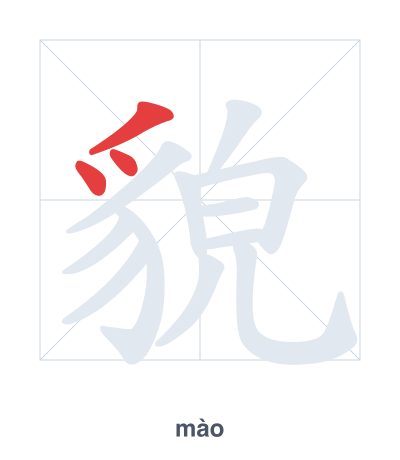
Open Hanzi Writer to see the animated stroke order and practice writing 貌 with real-time feedback.
The character 貌 (mào) is written with 14 strokes. Follow the standard Chinese stroke order: top to bottom, left to right, outside before inside. The radical 豸 is one of its key components.
Practice the correct stroke order with the Hanzi Writer app to see animated stroke-by-stroke guidance with real-time feedback.
貌 means appearance / look.
As an HSK Level 5 character, 貌 is an intermediate-level character.
The left side 豸 depicts a mythical beast, while the right side 皃 is a pictograph of a human face. Together they originally showed the 'face' or 'look' of an animal, later expanding to mean any appearance or look.
💡 Memory Tip: Imagine a beast (豸) staring at its own face (皃) in a mirror, checking its appearance.
他是一个有礼貌的孩子。
tā shì yí gè yǒu lǐ mào de hái zi
He is a polite child.
我们不能只看外貌。
wǒ men bù néng zhǐ kàn wài mào
We cannot judge by appearances alone.
城市的面貌发生了变化。
chéng shì de miàn mào fā shēng le biàn huà
The appearance of the city has changed.
Open Hanzi Writer to see the animated stroke order and practice writing 貌 with real-time feedback.
✨ Animated stroke order · Handwriting recognition · HSK-graded practice · Free to use
The character 貌 is made of two parts. The left side is the radical 豸, which originally referred to an animal, and the right side 皃 means "appearance." Together, they suggest the idea of how something or someone looks, linking the physical appearance of an animal to a face.