豺 (chái) means "Jackal" in Chinese. It has 10 strokes with the radical 豸.
Rated 4.2/5 in difficulty (advanced).
Appears in 3+ common words including 豺狼 (chái láng), 豺狗 (chái gǒu), 豺声 (chái shēng).
Due to its 10 strokes, Hanzi Writer's error detection shows 豺 requires focused practice — most learners need 10+ attempts for consistent accuracy.
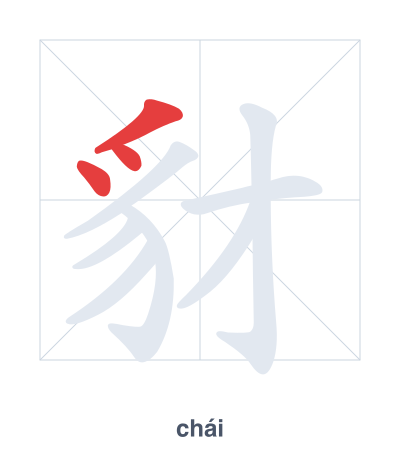
Open Hanzi Writer to see the animated stroke order and practice writing 豺 with real-time feedback.
The character 豺 (chái) is written with 10 strokes. Follow the standard Chinese stroke order: top to bottom, left to right, outside before inside. The radical 豸 is one of its key components.
Practice the correct stroke order with the Hanzi Writer app to see animated stroke-by-stroke guidance with real-time feedback.
豺 means Jackal.
| Character | 豺 |
| Pinyin | chái (chai) |
| Meaning | Jackal |
| Strokes | 10 |
| Radical | 豸 |
| Difficulty | 4.2/5 |
豺 is a compound character with the radical 豸 (beast) as the semantic component, indicating a wild canine, and 才 (cái, talent) as the phonetic hint. The ancient form of 豸 depicted a horned beast with a striped back, representing predatory animals.
💡 Memory Tip: Picture a sly jackal (豸) proudly showing off its 'talent' (才) for sneaky hunting.
豺狼在森林里。
chái láng zài sēn lín lǐ
Jackals and wolves are in the forest.
豺狗正在叫。
chái gǒu zhèng zài jiào
The jackal is howling.
他的声音像豺声。
tā de shēng yīn xiàng chái shēng
His voice sounds harsh and unpleasant.
Open Hanzi Writer to see the animated stroke order and practice writing 豺 with real-time feedback.
✨ Animated stroke order · Handwriting recognition · HSK-graded practice · Free to use
The character 豺 is formed by the radical 豸 (zhì), which means 'beast,' on the left, and the phonetic component 才 (cái) on the right. The left side indicates that the character refers to a wild animal, while the right side provides a clue to its pronunciation (chái). Together, they create the meaning 'jackal.'