豸 (zhì) means "Legless insect / Beast radical" in Chinese. It has 7 strokes with the radical 豸.
Rated 2.8/5 in difficulty (moderate).
Appears in 3+ common words including 獬豸 (xiè zhì), 豸绣 (zhì xiù), 豸冠 (zhì guān).
Hanzi Writer's stroke validation shows learners typically need 5-8 attempts to write 豸 with correct proportion and order.
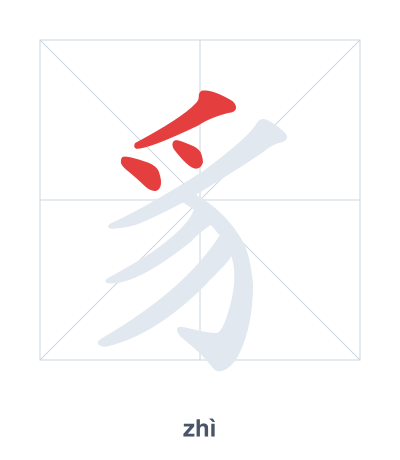
Open Hanzi Writer to see the animated stroke order and practice writing 豸 with real-time feedback.
The character 豸 (zhì) is written with 7 strokes. Follow the standard Chinese stroke order: top to bottom, left to right, outside before inside. The radical 豸 is one of its key components.
Practice the correct stroke order with the Hanzi Writer app to see animated stroke-by-stroke guidance with real-time feedback.
豸 means Legless insect / Beast radical.
| Character | 豸 |
| Pinyin | zhì (zhi) |
| Meaning | Legless insect / Beast radical |
| Strokes | 7 |
| Radical | 豸 |
| Difficulty | 2.8/5 |
The character 豸 originated as a pictograph of a mythical beast or legless insect, with ancient oracle bone and bronze inscriptions showing a creature with a large head, a long curved body, and a tail, resembling a lizard or worm without legs. The modern form still retains the sense of a crawling creature, often used as a radical in characters related to animals like 貓 (cat) and 狗 (dog).
💡 Memory Tip: Picture the top as a big head with antennae, the middle as a segmented body, and the bottom as a curled tail — a legless insect crawling like a 'ZHI' (zipper).
獬豸是古代神兽。
xiè zhì shì gǔ dài shén shòu
The Xiezhi is an ancient mythical beast.
衣服上有豸绣。
yī fú shàng yǒu zhì xiù
There is mythical beast embroidery on the clothes.
他戴着一顶豸冠。
tā dài zhe yī dǐng zhì guān
He is wearing an ancient censor's hat.
Open Hanzi Writer to see the animated stroke order and practice writing 豸 with real-time feedback.
✨ Animated stroke order · Handwriting recognition · HSK-graded practice · Free to use
豸 is a pictograph that represents a legless insect or a mythical beast. It is composed of a horned head at the top and a long, curved body at the bottom. As a radical, it appears in characters related to creatures, especially those with mythical or animal associations.