掠 (lüè) means "to graze or sweep past" in Chinese. It has 11 strokes with the radical 扌, and is HSK Level 7.
Rated 4.2/5 in difficulty (advanced).
Harder than 59% of HSK Level 7 characters.
Appears in 3+ common words including 掠过 (lüè guò), 掠夺 (lüè duó), 掠取 (lüè qǔ).
Due to its 11 strokes, Hanzi Writer's error detection shows 掠 requires focused practice — most learners need 10+ attempts for consistent accuracy.
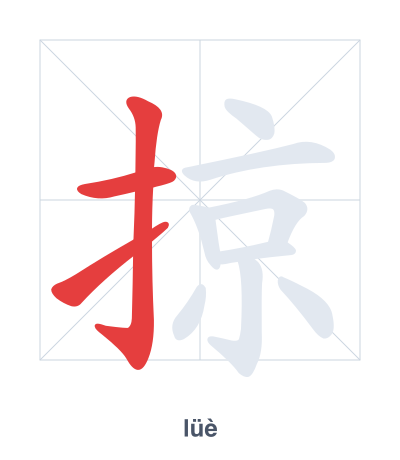
Open Hanzi Writer to see the animated stroke order and practice writing 掠 with real-time feedback.
The character 掠 (lüè) is written with 11 strokes. Follow the standard Chinese stroke order: top to bottom, left to right, outside before inside. The radical 扌 is one of its key components.
Practice the correct stroke order with the Hanzi Writer app to see animated stroke-by-stroke guidance with real-time feedback.
掠 means to graze or sweep past.
As an HSK Level 7 character, 掠 is an intermediate-level character.
The character 掠 combines the hand radical 扌 (shǒu, meaning 'hand') with the phonetic component 京 (jīng). The hand radical suggests an action performed with the hand, while 京 originally depicted a tall building or mound, contributing the sound 'lüè'. The overall meaning evolved from 'to take by force' to 'to sweep past or graze', reflecting a swift, hand-like motion.
💡 Memory Tip: Imagine a hand (扌) swiftly sweeping past a tall building (京), like a bird grazing the rooftop—quick and light, just like the character's meaning of 'to graze or sweep past'.
鸟儿从水面掠过。
niǎo ér cóng shuǐ miàn lüè guò
The bird skimmed over the water.
战争掠夺了财富。
zhàn zhēng lüè duó le cái fù
War plundered wealth.
他在掠取自然资源。
tā zài lüè qǔ zì rán zī yuán
He is plundering natural resources.
Open Hanzi Writer to see the animated stroke order and practice writing 掠 with real-time feedback.
✨ Animated stroke order · Handwriting recognition · HSK-graded practice · Free to use
The character 掠 is a phono-semantic compound: the left part 扌 (hand radical) indicates that the meaning is related to hand actions, while the right part 京 provides the pronunciation. The hand radical suggests physical actions like seizing or sweeping, which aligns with the meanings of 'plunder' and 'graze'. So the structure tells you it's an action done with the hand, and the sound comes from 京.