夺 (duó) means "to take by force / to seize / to win" in Chinese. It has 6 strokes with the radical 大, and is HSK Level 6.
Rated 3.2/5 in difficulty (challenging).
Harder than 10% of HSK Level 6 characters.
Appears in 3+ common words including 夺取 (duó qǔ), 争夺 (zhēng duó), 夺目 (duó mù).
Due to its 6 strokes, Hanzi Writer's error detection shows 夺 requires focused practice — most learners need 10+ attempts for consistent accuracy.
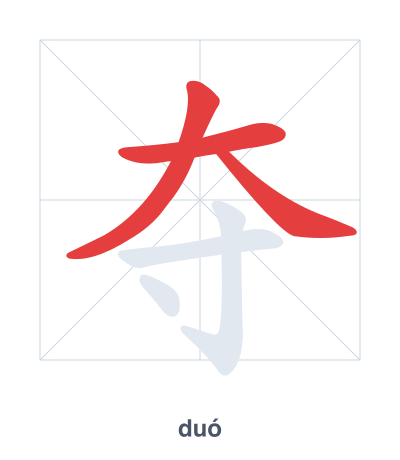
Open Hanzi Writer to see the animated stroke order and practice writing 夺 with real-time feedback.
The character 夺 (duó) is written with 6 strokes. Follow the standard Chinese stroke order: top to bottom, left to right, outside before inside. The radical 大 is one of its key components.
Practice the correct stroke order with the Hanzi Writer app to see animated stroke-by-stroke guidance with real-time feedback.
夺 means to take by force / to seize / to win.
As an HSK Level 6 character, 夺 is an intermediate-level character.
The character 夺 combines 大 (big) and 寸 (hand), symbolizing a hand grabbing a large object. This composition directly represents the action of taking by force or seizing something.
💡 Memory Tip: Picture a giant hand (大) with a smaller hand (寸) snatching a bird right out of the sky—no escape from the seizure.
他夺取了比赛的冠军。
tā duó qǔ le bǐ sài de guàn jūn
He won the championship of the competition.
孩子们在争夺玩具。
hái zi men zài zhēng duó wán jù
The children are fighting over toys.
她的裙子非常夺目。
tā de qún zi fēi cháng duó mù
Her skirt is very eye-catching.
Open Hanzi Writer to see the animated stroke order and practice writing 夺 with real-time feedback.
✨ Animated stroke order · Handwriting recognition · HSK-graded practice · Free to use
夺 consists of the radical 大 (big) at the top and 寸 (inch, representing a hand) at the bottom. The combination suggests a large person using a hand to forcefully take something, which relates to its meaning of seizing or winning by force.