瘤 (liú) means "tumor; growth" in Chinese. It has 15 strokes with the radical 疒, and is HSK Level 7.
Rated 4.2/5 in difficulty (advanced).
Harder than 73% of HSK Level 7 characters.
Appears in 3+ common words including 肿瘤 (zhǒng liú), 肉瘤 (ròu liú), 瘤子 (liú zi).
Due to its 15 strokes, Hanzi Writer's error detection shows 瘤 requires focused practice — most learners need 10+ attempts for consistent accuracy.
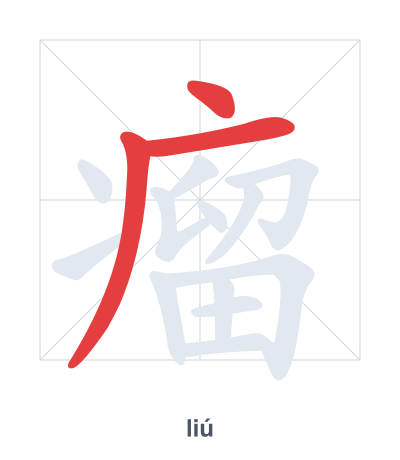
Open Hanzi Writer to see the animated stroke order and practice writing 瘤 with real-time feedback.
The character 瘤 (liú) is written with 15 strokes. Follow the standard Chinese stroke order: top to bottom, left to right, outside before inside. The radical 疒 is one of its key components.
Practice the correct stroke order with the Hanzi Writer app to see animated stroke-by-stroke guidance with real-time feedback.
瘤 means tumor; growth.
As an HSK Level 7 character, 瘤 is an intermediate-level character.
瘤 combines the illness radical 疒 (a bed with sweat, indicating sickness) with 留 (liú, meaning 'to stay' or 'remain'), which also provides the pronunciation. The tumor is thus visualized as an abnormal growth that 'stays' in the body, causing disease.
💡 Memory Tip: Imagine a sick person on a hospital bed (疒) who has a lump that just won't leave—it 'stays' (留) there, forming a tumor.
这是一个良性肿瘤。
zhè shì yí gè liáng xìng zhǒng liú
This is a benign tumor.
他的手臂长了肉瘤。
tā de shǒu bì zhǎng le ròu liú
He has a fleshy tumor on his arm.
他背上有一个瘤子。
tā bèi shàng yǒu yí gè liú zi
He has a lump on his back.
Open Hanzi Writer to see the animated stroke order and practice writing 瘤 with real-time feedback.
✨ Animated stroke order · Handwriting recognition · HSK-graded practice · Free to use
瘤 combines the radical 疒 (illness) with the phonetic component 留 (liú, meaning to stay). The radical shows it is a disease, while 留 suggests that a tumor is something that stays or grows in the body. Together, they form the idea of a growth that remains and does not go away.