排 (pái) means "row or to arrange" in Chinese. It has 11 strokes with the radical 扌, and is HSK Level 2.
Rated 3.7/5 in difficulty (challenging).
Harder than 76% of HSK Level 2 characters.
Appears in 3+ common words including 排队 (pái duì), 安排 (ān pái), 排除 (pái chú).
Due to its 11 strokes, Hanzi Writer's error detection shows 排 requires focused practice — most learners need 10+ attempts for consistent accuracy.
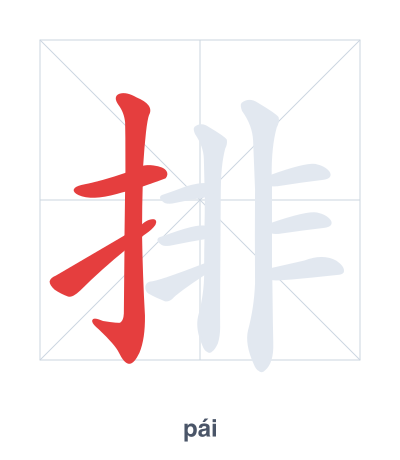
Open Hanzi Writer to see the animated stroke order and practice writing 排 with real-time feedback.
The character 排 (pái) is written with 11 strokes. Follow the standard Chinese stroke order: top to bottom, left to right, outside before inside. The radical 扌 is one of its key components.
Practice the correct stroke order with the Hanzi Writer app to see animated stroke-by-stroke guidance with real-time feedback.
排 means row or to arrange.
As an HSK Level 2 character, 排 is among the first characters beginners learn.
排 is a compound character combining the hand radical 扌 with 非, which originally depicted two opposing rows of birds in flight. The hand (扌) arranging items into orderly lines (like birds in formation) conveys the meaning of 'row' or 'to arrange.'
💡 Memory Tip: Picture a hand (扌) placing a row of 'non' items (非) into perfect alignment, like lining up dominoes.
大家都在排队买票。
dà jiā dōu zài pái duì mǎi piào
Everyone is lining up to buy tickets.
老师安排了作业。
lǎo shī ān pái le zuò yè
The teacher assigned homework.
我们排除了这个可能。
wǒ men pái chú le zhè ge kě néng
We have ruled out this possibility.
Open Hanzi Writer to see the animated stroke order and practice writing 排 with real-time feedback.
✨ Animated stroke order · Handwriting recognition · HSK-graded practice · Free to use
排 is made of the radical 扌 (hand) on the left and 非 (fēi, meaning 'not' or 'wrong') on the right. The hand radical suggests actions like arranging or pushing, while 非 adds the idea of lining up in two rows, as the left and right halves of 非 resemble two columns.