泪 (lèi) means "Tear" in Chinese. It has 8 strokes with the radical 氵, and is HSK Level 4.
Rated 3.7/5 in difficulty (challenging).
Harder than 47% of HSK Level 4 characters.
Appears in 3+ common words including 眼泪 (yǎn lèi), 泪水 (lèi shuǐ), 流泪 (liú lèi).
Due to its 8 strokes, Hanzi Writer's error detection shows 泪 requires focused practice — most learners need 10+ attempts for consistent accuracy.
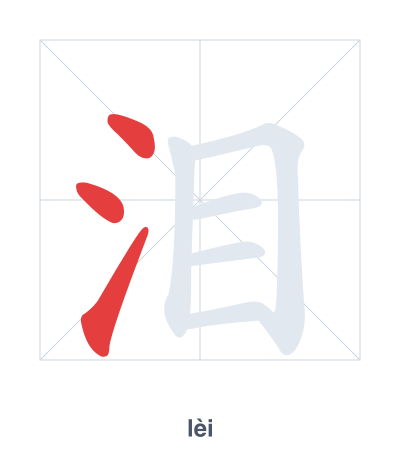
Open Hanzi Writer to see the animated stroke order and practice writing 泪 with real-time feedback.
The character 泪 (lèi) is written with 8 strokes. Follow the standard Chinese stroke order: top to bottom, left to right, outside before inside. The radical 氵 is one of its key components.
Practice the correct stroke order with the Hanzi Writer app to see animated stroke-by-stroke guidance with real-time feedback.
泪 means Tear.
As an HSK Level 4 character, 泪 is an intermediate-level character.
This character combines the water radical 氵 with 目 (eye), literally depicting water flowing from the eye. The simplified form replaces the more complex traditional character 淚, which had a phonetic component, with this direct visual compound.
💡 Memory Tip: Picture water (氵) squirting out from an eye (目) as a tear rolls down a cheek.
他流下了眼泪。
tā liú xià le yǎn lèi
He shed tears.
她的脸上全是泪水。
tā de liǎn shàng quán shì lèi shuǐ
Her face was covered in tears.
别为这事流泪。
bié wèi zhè shì liú lèi
Don't cry over this.
Open Hanzi Writer to see the animated stroke order and practice writing 泪 with real-time feedback.
✨ Animated stroke order · Handwriting recognition · HSK-graded practice · Free to use
泪 is composed of the radical 氵 (water) on the left and 戾 (lì, meaning 'to violate' or 'contrary') on the right. The water radical directly connects to the liquid nature of tears, while the right component 戾 adds the idea of something that should not happen, like sadness triggering tears. Together they form "water from sadness" or "involuntary water."