垒 (lěi) means "to build by stacking; rampart" in Chinese. It has 9 strokes with the radical 土, and is HSK Level 7.
Rated 4/5 in difficulty (challenging).
Harder than 38% of HSK Level 7 characters.
Appears in 3+ common words including 垒球 (lěi qiú), 垒墙 (lěi qiáng), 堡垒 (bǎo lěi).
Due to its 9 strokes, Hanzi Writer's error detection shows 垒 requires focused practice — most learners need 10+ attempts for consistent accuracy.
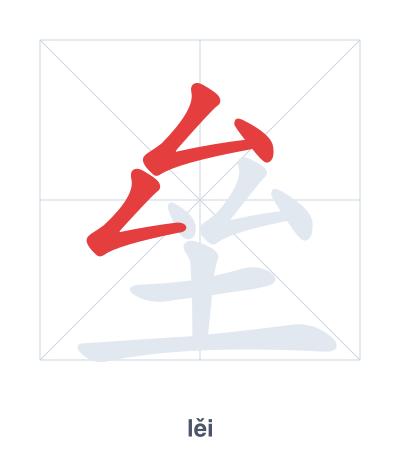
Open Hanzi Writer to see the animated stroke order and practice writing 垒 with real-time feedback.
The character 垒 (lěi) is written with 9 strokes. Follow the standard Chinese stroke order: top to bottom, left to right, outside before inside. The radical 土 is one of its key components.
Practice the correct stroke order with the Hanzi Writer app to see animated stroke-by-stroke guidance with real-time feedback.
垒 means to build by stacking; rampart.
As an HSK Level 7 character, 垒 is an intermediate-level character.
垒 is the simplified form of 壘, which originally depicted an earthen rampart. The top part 厶 represents a pile or enclosure, and the bottom 土 (earth) indicates the material. Together they convey stacking earth to build a defensive wall.
💡 Memory Tip: Picture a private (厶) mound of earth (土) that you stack up layer by layer to form a solid rampart.
我们下午去打垒球。
wǒ men xià wǔ qù dǎ lěi qiú
We are going to play softball this afternoon.
工人们正在垒墙。
gōng rén men zhèng zài lěi qiáng
Workers are building a wall.
这是一个坚固的堡垒。
zhè shì yí gè jiān gù de bǎo lěi
This is a sturdy fortress.
Open Hanzi Writer to see the animated stroke order and practice writing 垒 with real-time feedback.
✨ Animated stroke order · Handwriting recognition · HSK-graded practice · Free to use
垒 consists of the radical 土 (earth) on the bottom and the component 厶 (private) on top. The earth radical directly connects to the meaning of building by stacking materials like soil or bricks, while 厶 adds a phonetic hint for pronunciation lěi.